THE SHOCK OF THE NEXT NEUE KLASSE…
When a company announces a revolution, and that company is BMW, the world listens. What made this different? Not only the latest thinking on electrified powertrains, not only significantly increased vehicle to anything connectivity (‘V2X’), but a return to the important events that started in 1961 and came to define the whole company.
The OG Neue Klasse
BMW has had a very interesting and occasionally troubled past. In the 1950s it undertook manufacturing under licence from Iso, owned by Renzo Rivolta, to build the BMW Isetta 250 and 350 bubble car – and the stretched version, the 600. The model range at the time also included the 501, the V8 powered 503 GT coupe and 507 roadster – all were super expensive.
The gap needed to be filled to allow the company to build more cars and sell then at a bigger margin. Enter the BMW 1500 sedan, the beginning of a new dawn. It was not just a group of features but developed with deep knowledge. The humble BMW 1500 had a brand new M10 four-cylinder engine with 1499 cm3 producing 59 kW which featured a forged steel crankshaft, cast iron block, an aluminium cylinder head, hemispherical combustion chambers and a short stroke. It would reach high engine speeds effortlessly and was not expensive to make… our first clue.
Independent suspension all round, not unheard of but not common on mass market vehicles. The aim was to give better than average roadholding.
Front disc brakes as standard – this was uncommon on mass produced vehicles.
A well finished and stable body structure, with enough features to justify an above average price.
BMW did not have a lot of money to play with and needed cash flow fast. To make every single invested cent work, each decision needed to be taken carefully.
The engine, for example was expanded three more times so that by 1963, when the BMW 1800 appeared (engine upgrade, 1773 cm3 engine producing 81 kW), it became recognised internally as the real thing – the Neue Klasse. In 1965 the new Munich plant assembly halls for the BMW 1800 were complete, the same year the BMW 2000 appeared (engine upgrade, 1990 cm3 producing 96 kW).
Just across the road from the plant, construction had started that year on the stadium for the 1972 Olympic games…
The engine family was also used by the C/CS2000 coupe built by Karmann, and then….
A short wheelbase two-door car, the 1502, appeared. Then things really took off.
What became of these magic building blocks?
The BMW 1500 after 10 years morphed in the first 5 series, E12.
The BMW 1502 was built from 1966 until 1977, replaced by the first 3 series E21 introduced in 1975.
The BMW 2000 C/CS was re-engineered to become the 2800 CS E9, which evolved into the 3.0 CSL ‘batmobile’ by 1972. It was the precursor to the 6 series E24.
The Neue Klasse platform was underneath all of these in one form or another.
The crowning glory? The M10 block with a turbocharger almost as big, became M12 F1 engine which took Nelson Piquet in a Brabham to his second world championship. The M12 produced over the 1000 kW in qualifying and 600 kW in race trim. A true fusion of engine and turbocharger.
That clue…. all of this was essentially from one box of bits.
The big realisation
The formula worked well, but after a parade of challengers over many decades….. the arrival of Tesla Model 3 in 2017 aimed squarely at Audi A4, BMW 3 series and the Mercedes-Benz C Class with pure electric power was a huge challenge. This required a BMW deep innovation cycle.
2025 marked the unveiling of the next Neue Klasse which is, like the first Neue Klasse, a recognisable collection of bits.
Production of the first version – iX3 NA5 – from a new purpose build plant at Debrecen in Hungary, will be followed by a longer wheelbase iX3 NA6 to be built in China. Later in 2026 the i3 NA0/NA1 will appear – the new electrified ICE powered 3 series will also be unveiled in 2026. In total Neue Klasse will go on to power 40 unique- or upgraded models by 2030, of which at least six will be pure electric models.
The Munich plant was established in 1922 in the disused Bayerische Flugzeugwerke Aircraft works to build engines for tractors – commercial vehicles will cease internal combustion engine manufacturing by 2027. Engine manufacturing will continue elsewhere in the group.
The big bit
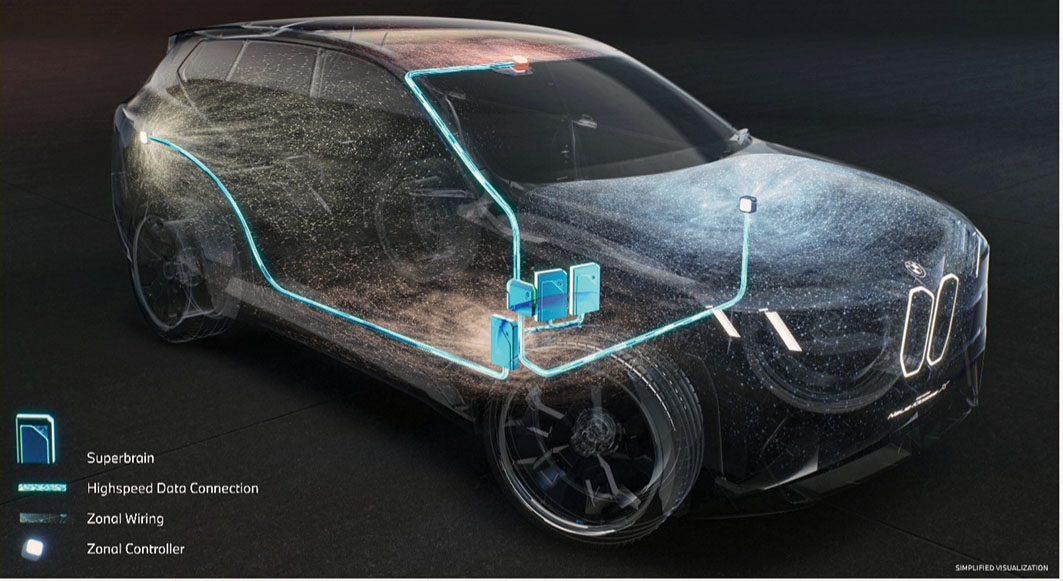
Now to the part where ‘software defined vehicles’ (‘SDV’) is contested. Central to Neue Klasse are four processors which share access to key services.
The four ‘Superbrains’ have separate functions:
1. ‘Core’: The module is connected to 50 sensors and looks after security, access, HVAC, data flow, interior and exterior lighting as well as over air updates. It processes information 10 times faster than previous generation systems.
2. ‘Panoramic iDrive’: The module controls the 3D head up display, the infotainment system, vocal control and central display – all connected in the iDrive way, and AI enabled. So that means endless corrections to ‘helpful’ alterations.
3. ‘Automated driving’: The module takes care of ADAS, integrating four previous generation processors into one unit which operates 20 times faster.
4. ‘Heart of joy’: The module takes care of acceleration, cornering stability, steering assistance and regenerative braking.
The system has many, many fine wire connections – although 600m less wire.
The four ‘Superbrains’ are connected to nodes around the vehicle, allowing a much-simplified harness with 600m less wire. The use of virtual fuses allows the wire core diameter to be minimised, further reducing the harness weight as well as cost.
So… SVD or not SVD?
Software engineers think any over air update can automatically transform a vehicle, but only if ultimately the hardware is fitted in the first place. So, the debate rages – is the Neue Klasse physical or virtual?
This confusion is because of the idea a few clicks from time to time and the car will simply ‘last for ever’, it will ‘evolve’ and ‘become better’. Ask anyone with any form of computer – and that includes smart phones – how’s that going?
The reality is, a vehicle is a physical device, it will last around four times longer than a phone, tablet or laptop, is more complex than any of those and literally is the difference between life or death whilst in motion.
For the repairer there is going to be much more information to come as more repair information gets published. Right now, this presents new issues, not least of which is those humble super thin wires. Just ask any aircraft technician about how easy it is to accidentally damage a harness while trying to remove and refit things.
A final thought on ‘Superbrains’
I’m not sure of the strategy, but having four modules clustered together in the region of the front bulkhead and inner A pillar may be traditional but does mean these parts might end up damaged during a partial overlap head-on collision, where the front wheel will try and move back into the A pillar area.
Just a thought … Could be wrong, and I hope I am.
By Andrew Marsh