MISSING PARTS – INTERNATIONAL TRADE DISPUTES AND INTERNAL COMPANY RUCTIONS
We are painfully aware of ‘on back order’ or ‘no delivery date’ when ordering parts. Given the international tensions between the USA, EU27, UK and China – plus other regions – trade disputes at company level can end up as part of a bigger international dispute.
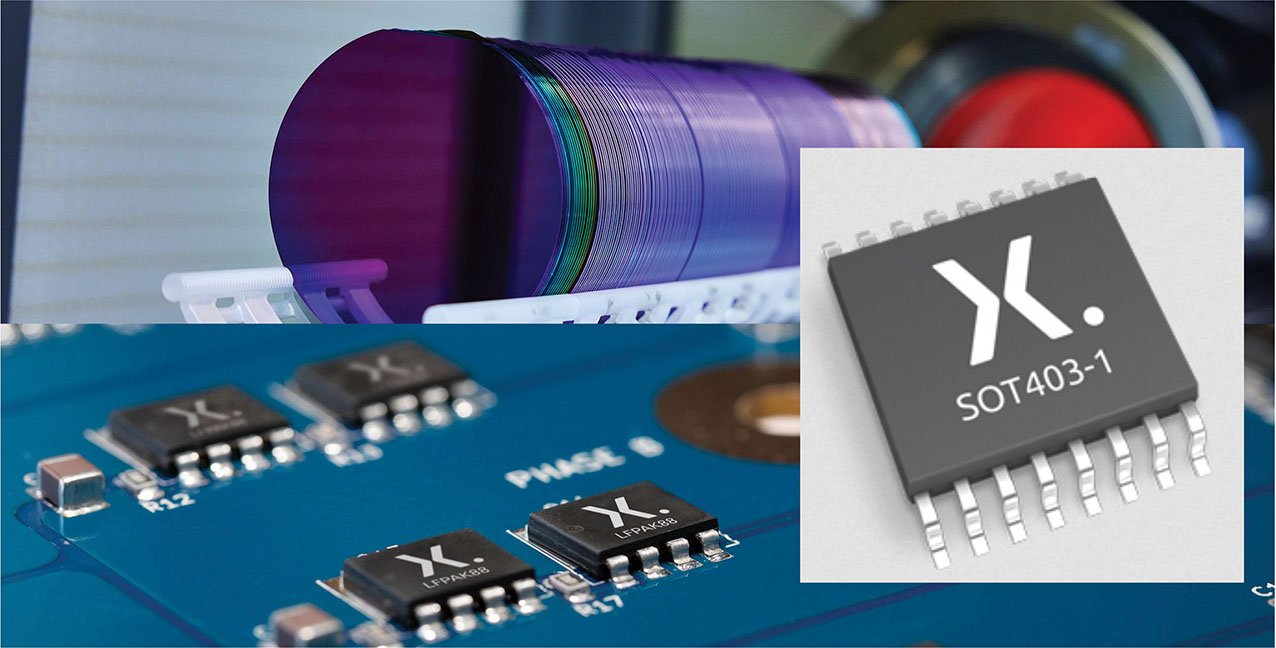
Surface mounted wonders
Inside each electronic module there will be a circuit board, a main processor, and a gaggle of inexpensive smaller components, all encased in a plastic box. Should any one of these become unobtainable, the sub-assembly cannot be made. The companies making such parts can be Tier 3 or 4 suppliers – a long way from the finished assembly the body shop is trying to buy.
Nexperia, a former Philips company now owned by Wingtech, makes small controller components which are fitted inside many, many control modules. Their products and service levels are so reliable that few Tier 1 suppliers or vehicle manufacturers believed there could ever be an issue.
The company started as Mullard Radio Valve Co. Ltd. of Southfields, London, in 1920, with help from Radio Communication Co., to compete with Marconi for Royal Navy communications contracts. This was also at the very the start of the mass-market radio revolution. By 1924, the foundation of the BBC forced the company to seek investors, with Philips buying half the company, before acquiring full ownership by 1927.
By the mid-1950s Philips started making their first solid-state switches (transistors) in Nijmegen in the Netherlands. Production expanded via the UK, Germany, Hong Kong and the USA by the 1970s. In 1988 the Mullard name was replaced by Philips Components Ltd; annual output was three billion solid-state devices per year, which later became Philips Semiconductors Ltd.
In 2006 yet another re-name: NXP, which later hived off the solid-state device unit into ‘Nexperia’, with Beijing Jianguang Asset Management and Wise Road Capital (both from China) buying shares in 2016. Annual production reached more than 100 billion solid state devices per year.
Wingtech Technologies bought Nexperia during 2019. By this stage, parts of the silicon wafer and base component production were in the Netherlands, with components finished and tested in China before export worldwide. – a truly global operation.
Concerns from the Netherlands
From 2022 onwards senior management of the Dutch part of Nexperia informed the Dutch Government about concerns including:
• Apparently setting up alternative bank accounts to divert customer money to China without informing clients.
• Apparently trying to de-register Nexperia patents in the Netherlands and set up China versions.
• Apparently discovering a plan to remove silicon wafer production lines and other specialist equipment from the Netherlands to China.
• Allegedly, Nexperia China failed to pay Nexperia Netherlands for some silicon wafer shipments.
The Dutch Government implemented a law to take over the Dutch part of Nexperia, on 30th September 2025 and to remove the CEO.
Concerns from the USA
The U.S. Commerce Department added Wingtech to an ‘entities watch list’ in December 2024 (Biden administration). This required Wingtech to apply for licences for any USA technology it needed to use. From September 2025 (Trump administration), the action was extended to cover all subsidiaries of Wingtech, such as Nexperia.
In an attempt to by-pass the rule, Nexperia in China formally declared independence from Wingtech – a move not recognised by the U.S. Commerce Department.
The Dutch part of Nexperia told the U.S. Commerce Department that it would comply with all requirements.
Defence and concerns from China
At company level, Nexperia China told some staff in the Netherlands to ignore all European staff and that they would be paid regardless of events. There was diplomatic outrage from China towards the Dutch and USA governments, accusing them of collusion. The China Government demanded the release of the Dutch company and reinstatement of the CEO.
The upshot
In effect, from 30th September the supply chain inside Nexperia was broken, leaving vehicle manufacturers and their main Tier 1 suppliers with nothing more than the components in store. Within two weeks, alerts came from the USA, Japan and Europe as Nexperia component production stoppage affected a large part of the automotive industry.
Some vehicle and sub-assembly manufacturers reached for the extra-big credit card to buy out stocks wherever they could find them, while others pushed alternative sources to increase production. In parallel a presidential meeting between Mr Donald Trump and Mr Jinping Xi on the 29th of October 2025 went well, although USA and China had rather different views about what was achieved.
The Dutch Government made approaches to China along the lines of handing back control of the Dutch plant.
The fight is not over
The way China announced limits on rare earth metal export in April then extended the number of metals along with even tighter controls in October 2025, came as a shock. China has spent four decades acquiring mining rights and building the systems needed to process up to 90% of the global supply of key materials. This was a demonstration of absolute control. There was considerable provocation from the USA during this period, and it forms part of a wider global struggle for supremacy.
The EU27 and UK combined GDP is larger than that of USA or China, so perhaps the collective European voice should be heard. We are not just a political football.
By Andrew Marsh