A PANEL REVOLUTION IN PLAIN SIGHT
It was in a meeting with BMW UK, the body repair specialist lead engineer from BMW Group and Matthew Avery, at Thatcham Research. It was one of those meetings where it might be said ‘you have got to be…’, but definitely worth listening to every single word. BMW UK were listening to the information for the very first time as well.
Structural bonding had been around for a while, especially with aluminium intensive bodies. This BMW Group calmly explained these were steel bodies, welded in manufacture but selected repairs would be completed with bonding as well as mechanical fasteners. The BMW UK representative was very, very uncomfortable, and we all listened in slight shock.
What about? … What about? Each question was answered with ‘this is the mandated solution and non-adherence would mean voiding the body corrosion warranty. More ‘what about?’ followed. Eventually we saw the logic (cold repair, less energy, faster turnaround), saw it was not applied universally (chassis leg sections, some other structural panels and some non-structural panels) and ordered the new materials in.
Thatcham Research followed the procedures, discussed some of the points with BMW Group, and with some reservation, backed the idea. Fast forward to 2025 and there are still repairers who don’t like it, don’t want to do it and add loads of ‘what about?’ However, not one manufacturer has produced a steel alloy body shell with bonded and riveted steel alloy sub-assemblies for repair. A step too far?
Late 2024
Compared to nearly 18 years before, we now know a vehicle manufacturer has body architecture. That covers the main electric system function/layout, types of fuel systems, types of power units, two- or four-wheel drive, and every kind of upper profile – coupé, convertible, sedan, estate, bakkie – you could imagine.
The body is ‘just’ another system, capable of being made in multiple steel alloys for higher volume / lower cost, or mixed steel with aluminium alloy parts for lower volume / higher price cars. Many manufacturers use this approach, which allows them to move relatively quickly between competing technologies as the price of the sub-assembly changes due to external influences (China stockpiling key materials, for instance). In this way most manufacturers cover many, many, models with a handful of these architectures.
Tesla may not be relevant to South Africa, but the latest Model 3 facelift, called Project Highland, is much, much more than a new interior, bumpers and external lights.
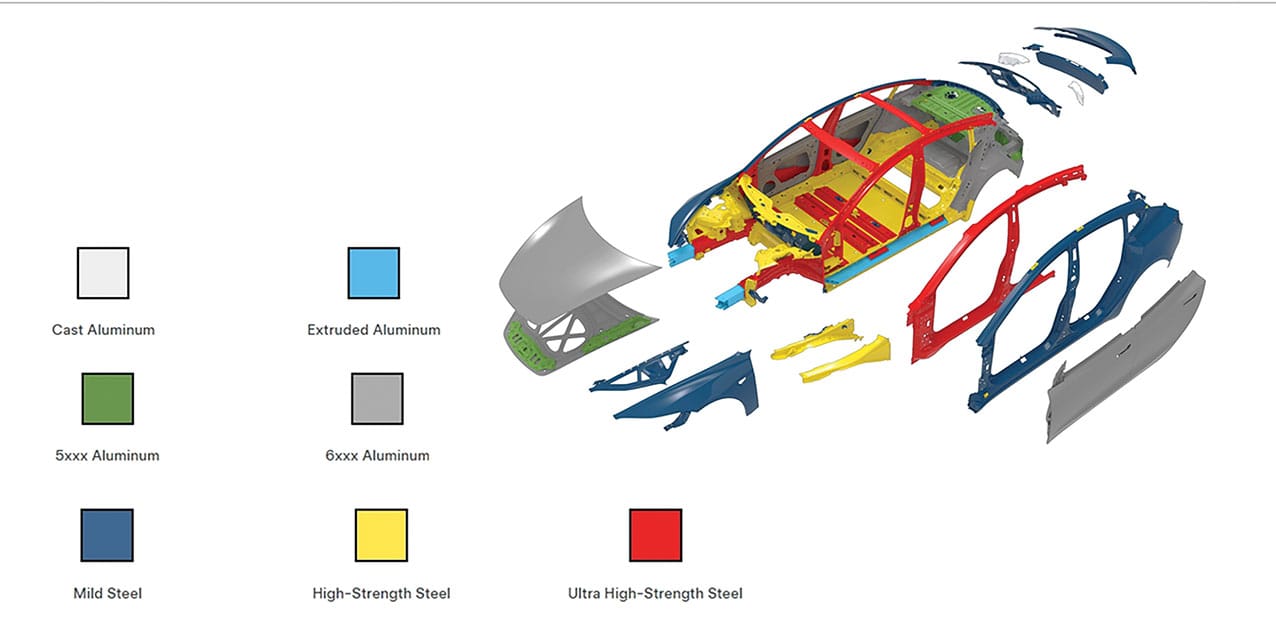
Introduced in 2017, Tesla Model 3 was a big departure from Models S and Model X, both of which had aluminium alloy intensive bodies. To reach greater volume at lower cost, Model 3 used a steel alloy bodyshell with aluminium alloy used for the doors, front lid, rear parcel shelf, the bumper beam crush elements and the sill reinforcement crush element (yes, 2 reinforcements). Mild steel alloy was used for the front wings and outer body side.
The repair process was fairly complex but well documented. Then came large scale pressure die castings, or as Tesla call them, Megacastings. Lots of manufacturers followed suit, using the Megacastings mainly for the boot floor and rear chassis leg section over the rear powertrain. Tesla went a step further, introducing ‘Megacastings’ for the re-engineered Model S and X, as well as Model Y with a ‘structural’ battery pack build in Austin, Texas.
The original Tesla Model 3 front structure repair procedure called for a mix of welding as well as rivet/bonding, covering several individual panels. This permitted three possible section points.
Tesla Model 3 Project Highland promised the introduction of a front ‘Megacasting’ – but no.
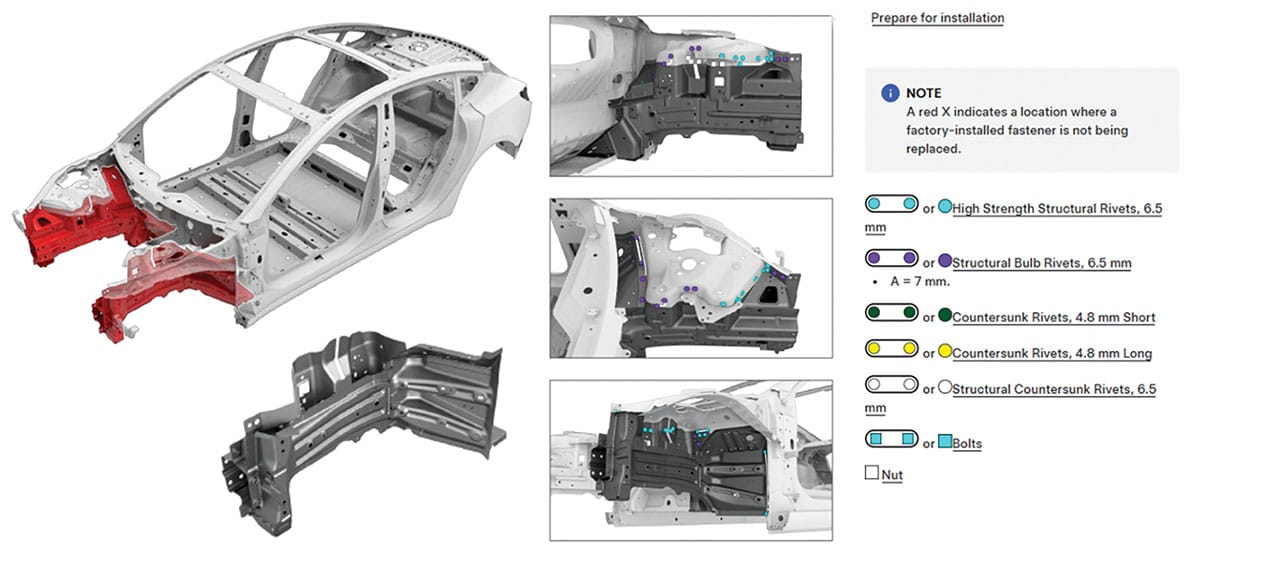
Tesla Model 3 ‘Project Highland’ has a steel alloy front chassis leg sub which interfaces with the front firewall. A steel alloy structure welded in manufacturing, but bonded and riveted in repair. There are two large sub-assembly options and only use rivet / bonding:
1. Front chassis leg
2. Front chassis leg and strut tower.
The sub-assembly makes a major repair easier, but only a very short chassis leg section close to the front bumper beam crush element is otherwise available.
The result? The 2024 Model 3 repair is not the same as a pre-2024 Model 3. Tesla provide ample information on this, and so repairers need to ensure they have the correct researched information before starting the job.
In one model year facelift Tesla revised the body repair processes on the following structural parts; Front chassis leg Front upper longitudinal outer:
Front upper longitudinal inner
A new front chassis leg to front upper longitudinal brace, which helps with small frontal offset impacts.
Rear chassis leg section – upper, reinforcement and lower.
So, we need to be careful not to make assumptions because the car looks like previous versions.
The wider point
The process gives Tesla the ability to introduce a sub assembly made from different materials, such as aluminium alloy, as the component cost, investment and production volumes allow. By proving the major interface of the front chassis leg to front bulkhead joint on a major high-volume product such as Model 3, Tesla can apply changes with increased confidence.
The collision repairers need to be aware such ‘switches’ could take place.
We can be sure every single manufacturer from Shanghai to Detroit will have noticed this. Bit by bit the concept of removable ‘corners’ edges closer to reality, although more than 30 years after the idea was first promoted by… BMW.
By Andrew Marsh