UNDERSTANDING NEW EV REPAIR TECHNOLOGY
As Electric Vehicle (EV) growth accelerates, brought on in part by huge increases in fossil fuel costs in recent times, the car park landscape is changing fast. With a huge number of EV models now on offer in South Africa, from more than 22 manufacturers locally, these vehicles require a radical shift in best practises to ensure operator safety and repair efficiency in key areas of the repair cycle involving the disconnection of high-voltage components and more.
All this activity will require extensive training, currently available in a four-stage modular programme, enabling technicians to become expert-trained to international certification standards.
Technical equipment
It is vital that operators use specially insulated, made-to-measure safety helmets and face protection. This equipment will safeguard the face, neck and other vulnerable areas, providing insulation against electrical risks at all times.
Appropriate charging points must also be available to balance the delivery of the correct amount of energy to the vehicle under repair, ensuring that a recharged battery meets the necessary protocols safely and efficiently.
Zone technology
Clearly marked repair zones are vital, while overhead drop-down fire blankets and other fire-reduction measures need to be installed, along with specially recommended fire extinguishers, to mitigate the ever-present risk of thermal runaway and meet OEM repair requirements.
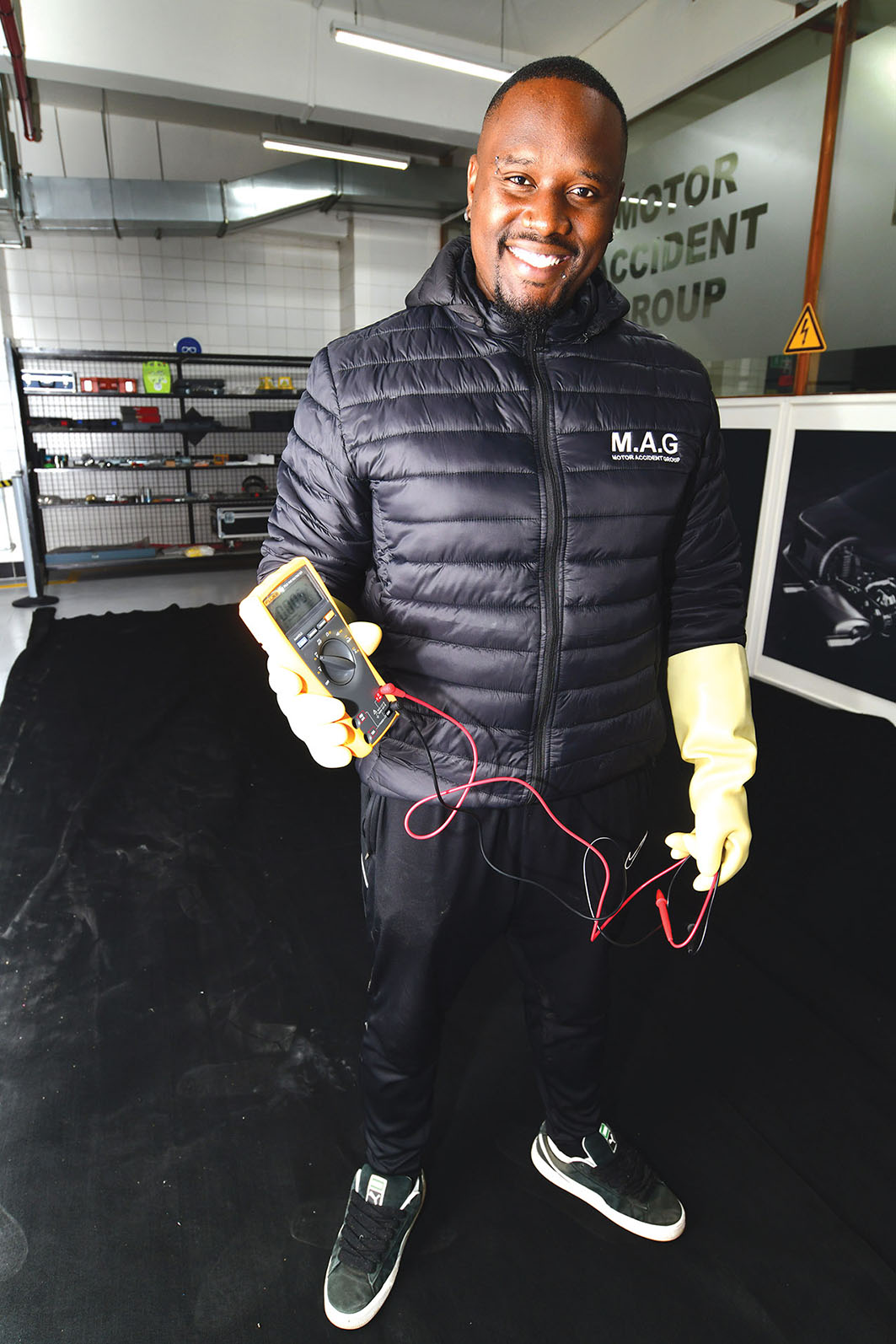
Any deviation from hard-and-fast safety procedures could result in a fatal outcome for your repair staff. Therefore, EV-mandated hand tools complying with IEC 60900, electrical test equipment meeting CAT III/IV requirements, Class 0 high-voltage gloves with leather protectors, and appropriate PPE will all become essential.
Self-contained breathing equipment is essential as there may be damaged EV batteries that could result in thermal runaway and release toxic, flammable gases such as hydrogen fluoride, carbon monoxide, and phosphoryl fluoride. If breathed in, it will be the last breath you ever take as these gases are deadly.
An EV rescue hook is an insulated safety tool used to pull an electrocuted or incapacitated worker away from the EV. It’s made with fibreglass or epoxy resin that has an insulated shaft and withstands up to 1000 volts.
The Automated External Defibrillator (AED) is a critical piece of safety equipment required in workshops that service electric vehicles (EVs) and hybrid vehicles due to the high-voltage risks involved.
Specialised lithium-ion fire extinguishers use agents like Aqueous Vermiculite Dispersion (AVD) or water-based gels to cool burning battery cells and create a thermal barrier, unlike standard extinguishers which are ineffective.
An EV fire blanket is a high-temperature resistant cover used to isolate electric vehicle fires, contain toxic smoke, and restrict oxygen.
These are some of the tools that are required to safely repair EVs.
Rethinking EV repair
South Africa has seen a relatively slow adoption of EVs, largely because of the limited availability of charging points. However, things are changing with the rapid uptake of hybrid vehicles – one in every 17 vehicles is hybrid or BEV as per the latest stats locally.
It is important to know whether we will ultimately be able to develop the infrastructure required for EV charging stations. This has been part of the lacklustre attraction of these vehicles in SA. Embracing this additional form of EV demand going forward is essential.
In addition, EV-specific lifts, battery lift tables and precision measuring equipment will all require significant investment as body shops prepare for the inevitable expansion of EV repair work and the sector’s continuing growth.
Find out about courses that you can attend to future proof your business for hybrid and EV repair.
Contact MAGALS Training Academy at +27 (0)10 110 0435 or email procurement@magalsacademy.co.za
Story and pics by Ian Groat