TIPS FOR IDENTIFYING AND FIXING COATING DEFECTS
Reducing defects leads to improved efficiency, less rework and most importantly, greater customer satisfaction. By helping you recognise and minimise these issues, you can consistently achieve high quality results. Defects are an unavoidable challenge in the automotive refinishing industry. Coating imperfections can arise from various factors, including accidents, exposure to harsh substances, poor application methods, or incorrect paint formulation. Here are four examples, their causes and how to prevent them, as well as how to fix the problem.
Yellowing clearcoat
A clearcoat that is yellowing is due to discoloration causing the appearance of a colour mismatch to the adjacent panel after the clearcoat is applied.
Origin and potential causes:
- Incorrect clearcoat film thickness
- Wrong or contaminated hardener/activator.
Prevention techniques:
- Ensure lids are tightly replaced after using activators or hardeners.
- Follow recommendations per technical data sheets
Use recommended system activators
Remedy
Allow the finish to properly dry, then sand and refinish.
Mismatch fading colour
The colour of the repaired part differs from that originally on the object being painted.
Origin and potential causes:
- The appropriate formula or alternate was not used.
- Incorrect spray gun setup or PSI.
- The original finish has changed due to weathering or exposure.
- Incorrect application technique (especially applicable to metallics), too wet, too dry, poor hiding or coverage.
- The colour was not well stirred.
- Variations of the OEM finish.
Prevention techniques:
- Check colour for variations and use the right formula.
- Stir colours thoroughly.
- Polish adjacent panels to check the colour.
- If necessary, follow the instructions of an old colour guide to match the old finish colour.
- Use the spraying technique which better adapts to the required colour matching.
- Spray a test panel for colour verification.
- Blend the colour into adjacent panel(s).
Remedy
Sand and refinish after having chosen the right formula, tinted the existing formula and/or set up the repair for a blend.
Corrosion
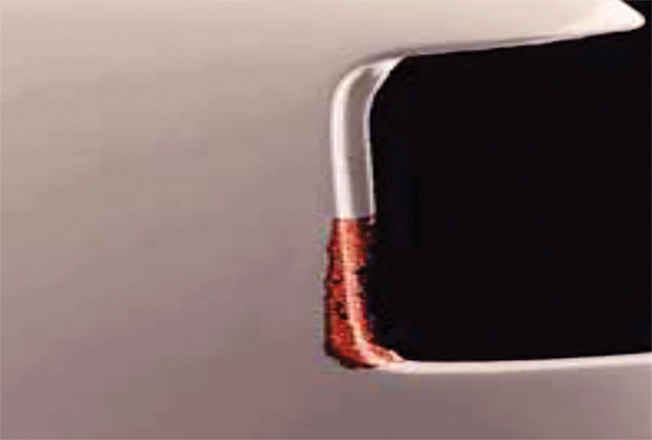
Surface of metal substrate is visible and shows corrosion spots. Brownish red for steel, white rust in the case of aluminium substrates.
Origin and potential causes:
- The surface of the metal was contaminated (fingermarks, water) before application.
- Paint removed by chipping, scratches, etc.
- Inadequate pre-treatment of the metal surfaces.
- Rust was not completely removed before refinishing.
- Destruction of paint film by contamination.
Prevention techniques:
- Treat metals with correct metal treatment and wash-primers.
- Repair all chips and scratches before rust develops.
- Cleaner the vehicle thoroughly before applying refinish system.
- Residue of water from sanding still on the surface should be wiped off and allowed to completely dry before applying refinish system.
Remedy
Strip the paint or sand back to bare metal.
- Use the metal conditioner and a phosphoric acid wash primer (etch-primer) applicable for the substrate.
- Refinish.
Cracking
A series of deep cracks resembling mud cracks in a dry pond. Often in the form of three-legged stars and in no definite pattern, they are usually in the colour coat and sometimes the undercoat as well.
Origin and potential causes:
- Excessive film thickness. Excessively thick topcoats magnify normal stresses and strains which can result in cracking even under normal conditions.
- Materials not uniformly mixed.
- Insufficient flash times between coats.
- Incorrect use of additives.
- Substrate is too hot or cold.
- Use of coats incompatible with each other.
- Omitting the activator when mixing a 2K product.
Prevention techniques
- Don’t pile on topcoats. Allow sufficient flash and drying time between coats.
- Do not dry by fanning with compressed air from the spray gun.
- Stir all pigmented undercoats and topcoats thoroughly.
- Additives not specifically designed for a colour coat may weaken the final paint film and make it more sensitive to cracking so make sure to read the recommendations on the technical data sheet.
Remedy
The affected areas must be sanded to a smooth finish, or in extreme cases removed down to the bare metal, and a full refinish system reapplied.