THE STRANGE JOURNEY OF AN ITALIAN-BODIED TRIUMPH TR3
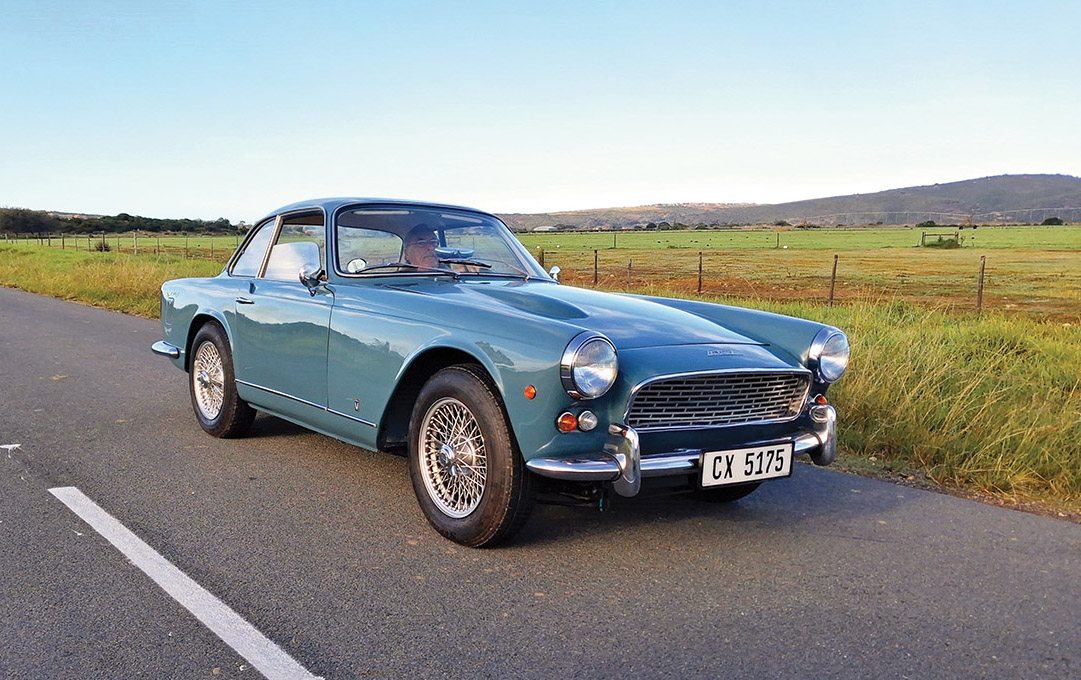
How, as you may well ask, did an exotic-bodied Triumph TR3 end up in a lock-up in the southern Cape, some 60 years after it was lovingly pieced together in Turin in 1962? The specific journey of the only Triumph Italia 2000 in Africa is possibly even more interesting than the fact that it was number 281 of just 330 Triumph Italia models built between 1960 and 1962.
The first owner was apparently an Italian Contessa that bought the car off the floor at the 1962 Paris Automobile Salon. It is not known how long the Contessa’s flirtation with this Anglo-Italian hybrid lasted, but it is known that the car ended up in the Middle East, and specifically Israel, in the early 1970s. The current owner, Triumph fanatic Brian Gibson (he is the driving force behind the Garden Route Triumph Club in Knysna) confirms that he discovered a number of shekels beneath the carpeting of the car when he was preparing it for a car show, soon after taking ownership.
The first South African owner of this car was one of the singing stars of the well-known stage musical, Jacques Brel is Alive and Living in Paris, which was directed by one of South Africa’s best-known entertainment figures of the 1970s, Taubie Kushlik. Jean Dell first registered the Triumph Italia in Johannesburg in 1975 with the rather special number, TJ 389.
A few years after buying the car, Jean Dell died, and the Italia was inherited by her brother, John Stodel. Apparently, the sexy little car had by this stage lost a fair amount of its pristine show charisma, and when it ran out of fuel outside the Wits University squash courts, Stodel simply abandoned the car to the elements for a spell.
It was here that the next significant figure in the sports car’s life came into the frame. John Sim was leaving the squash courts one evening when his car’s headlights swept over the bodywork of a dusty car parked off in a corner of the lot. And within that brief instant, he knew he was looking at what was probably the rarest Triumph in the country.
John Sim had owned a Triumph Spitfire a few years previously and was so taken with the smallest sports car in Triumph’s range that he became an expert on every Triumph that had ever left the company’s factory in Coventry. Including those that had left the factory in chassis form, destined for the fitment of Italian bodywork in Turin.
Thus, the only Triumph Italia in Africa was recognised by probably the only person in Africa who realised what he was seeing! Go figure the odds on that happening, and you’ll agree that if this was a movie script the confluence in Braamfontein would have been rejected as way too far-fetched.
Stodel may not have felt any urgency to rescue his car – it turned out that it had simply run of fuel – but he was not unaware that his late sister had bequeathed a car to him that had a considerable amount of value, despite its excess of what would fondly be referred to by some as “patina”.” When John Sim told him he wanted to buy the car the price was set at a not inconsiderable figure of R650, substantial for a well-used 15-year-old sports car in 1977.
However, Sim felt the car was valuable enough to borrow the money from his future father-in-law and after returning to the squash courts with a five-litre can of fuel, he drove the car to his mother’s house in Roosevelt Park and parked it for what would turn out to be the best part of three decades.
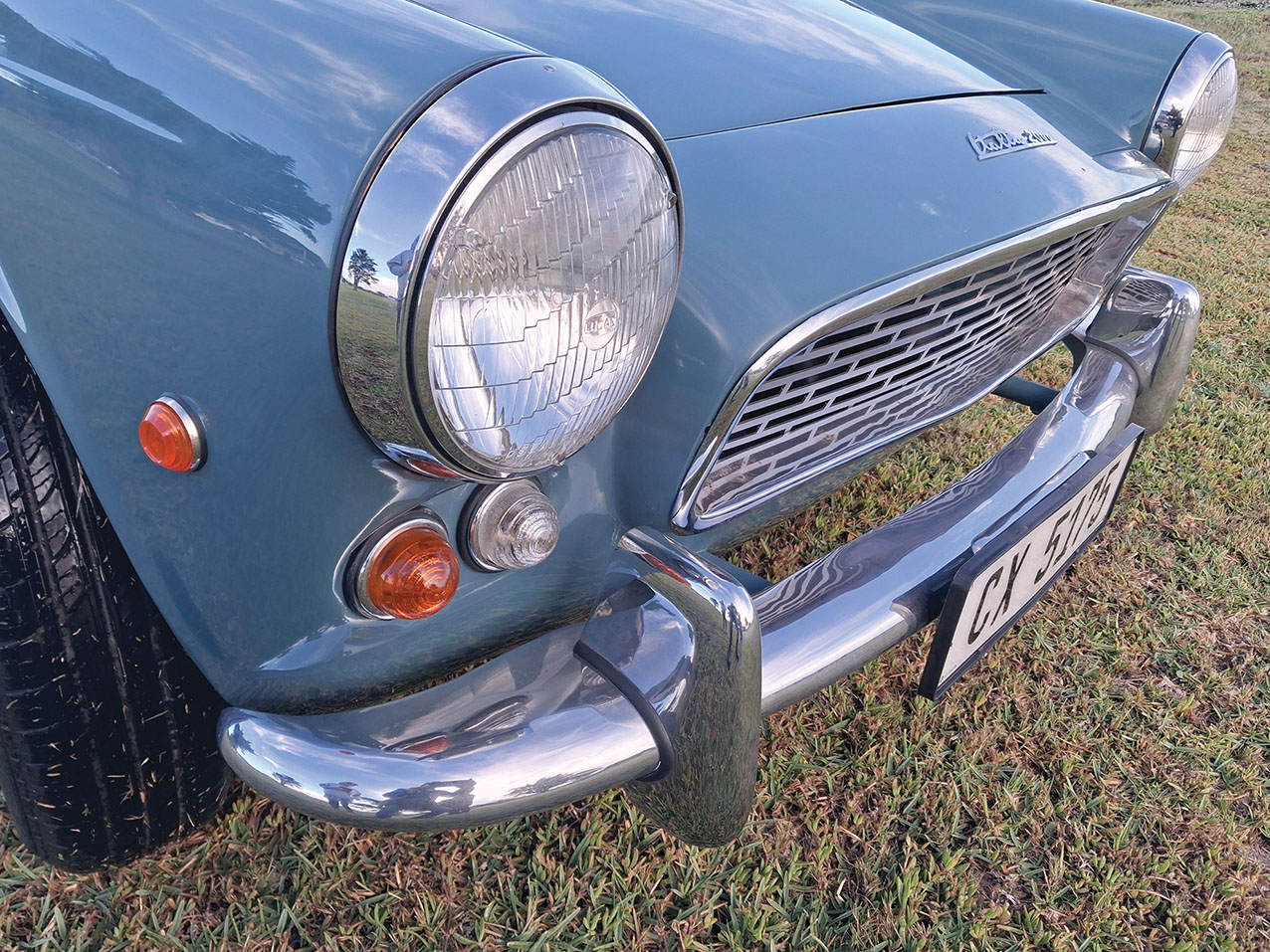
Eventually Sim realised that he was never going to get around to restoring the car, and he sold it to the third John in this story, John Dobbins, who undertook a thorough and accurate restoration. When current owner Brian Gibson bought the car from Dobbins, the only item he had to have made was the radiator grille. This is quite remarkable, considering that, like many Italian low-volume cars of that period, many items had been sourced from more common production cars which had since disappeared from the market. One of these obscure marques, for instance was the Austin Metropolitan, which provided the headlights for the Italia.
Apart from ensuring that the car was well stored during all those years, and didn’t deteriorate any further, the most valuable thing that John Stodel did was to pay the licence fee each and every year. “Which saved an awful lot of bother for me when I bought the car,” says current owner Brian Gibson.
Gibson owns just about every significant Triumph sports car that has been built in the past 70 years, and he is well aware of how special his car is.
The writer got a chance to drive the Italia when the Triumph Owners Club held a national get together in Hartenbos recently – a town located just a few kilometres outside Mossel Bay. I must say I was excited to drive the car, firstly because my experiences of Triumph sports cars had always been favourable, and secondly to see how the British chassis and drivetrain matched up to the body work of obviously immense flair.
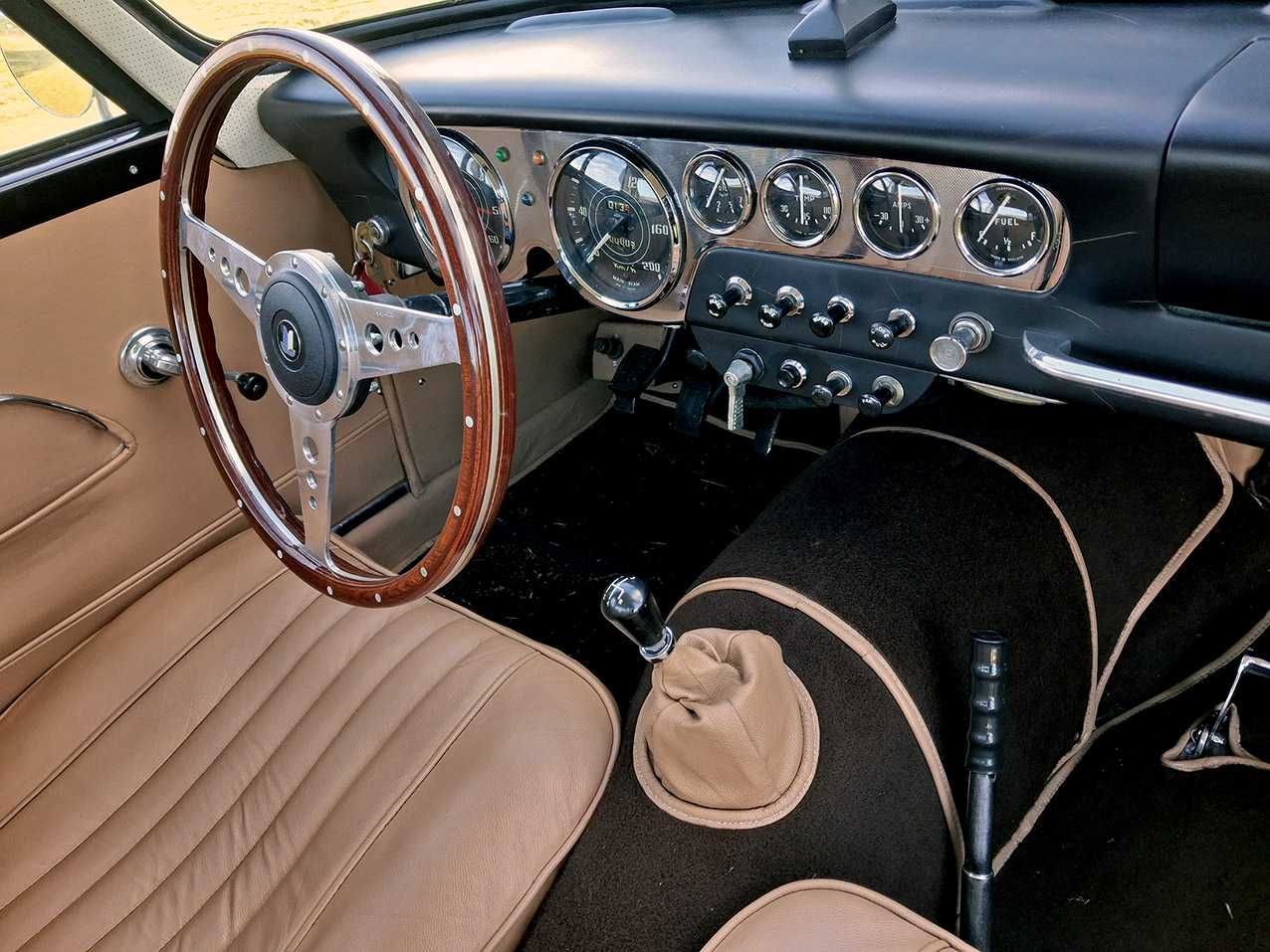
My overriding impression is that, dimensionally, the car is a tight fit for average-sized South African males, but that the very snugness imparts its own special charm. I was also impressed with the restoration as well as the basic build quality of the car. The fact that the Italia is left-hand-drive didn’t bother me at all, as in the course of my career I had done plenty of motoring in Europe, and the muscle memory in my right-hand for gear changes was still ready for call-up duty. The only challenge I had was to remember that there was no synchromesh on first gear, and to likewise remember, even when stationary, to depress fully the rather stiff clutch pedal firmly, before attempting a shift into first!
The Triumph engine fitted to the Italia is the 2,2-litre version as fitted to the TR4A models and good for over 100 horsepower, along with such good low-rev torque that shifting into first gear is an option that is entirely arbitrary.
The trick with a Triumph of TR3 persuasion is to shift into top as quickly as possible and simply luxuriate in the stupendous pulling power on tap. Nevertheless, I did try winding it out through the gears on occasion, and, yes, with a light body and little frontal area, I am happy to report that the Triumph Italia is more than fast enough to raise the pulse rate.
The Italia body, built by Vignale in Turin, but designed by the famous Giovanni Michelotti outfit, combines classic clean styling with a lot of rigidity, being made of steel and residing on the standard (separate) TR3 chassis. The lasting impression is of a surprisingly solid car that belies the delicacy of its styling.
Handling, thanks to stiffer rear leaf springs, beefed-up front shocks and an anti-roll-bar, was very re-assuring.
In fact, in a broad sense this is the ideal sort of classic car to buy – an exotic body with uncomplicated underpinnings that gives the best of both worlds. A formula that, indeed, made the Karmann Ghia such a popular car, despite being based on the least charismatic mechanicals you could imagine – those of the Volkswagen Beetle!