THE RISE OF LUXOR PAINTS
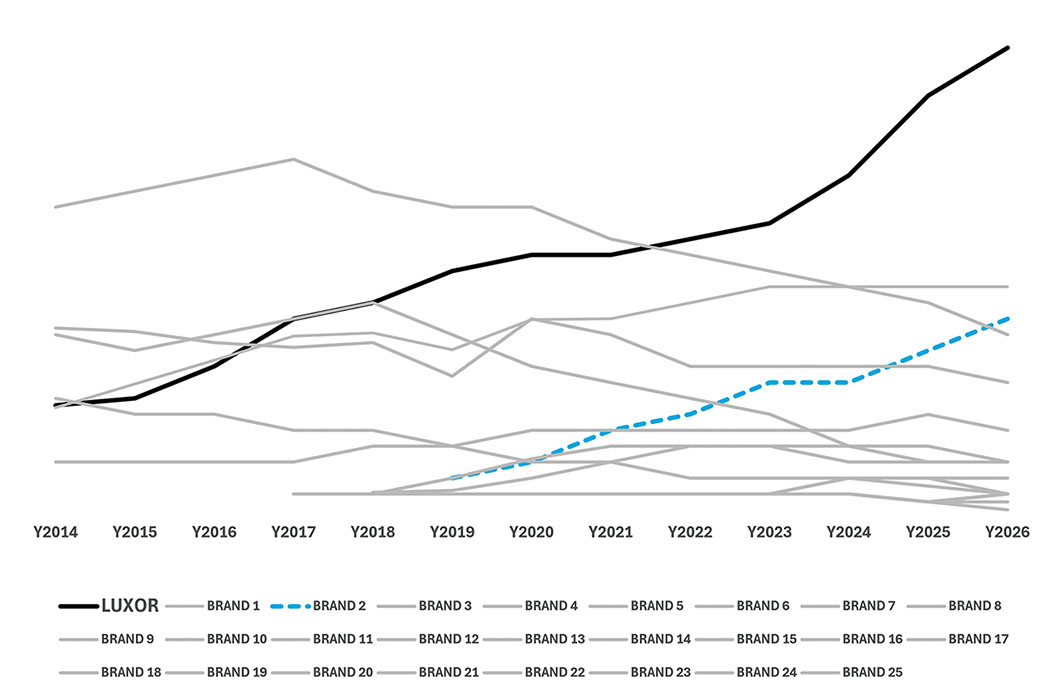
For more than a decade, one of the most interesting stories in the South African automotive refinish market has been the growth of Luxor Paints. Long-term market tracking since 2013 by Real Research, shows Luxor continuing their upwards trend into 2026. Recent market conversations, interviews and tracking data suggest that its growth has continued, pushing its market share above 40% in litres and rands. Added to this leading share are Luxor’s customer service and support ratings, which have once again identified it as the number one value brand.
The interesting question isn’t simply how much Luxor has grown. It is why. Market share rarely moves dramatically because of one product, one marketing campaign or one lucky break. Sustained growth usually comes from understanding where the market is going and positioning the business accordingly. And there are several lessons in the Luxor story that are relevant to every coatings manufacturer and supplier operating or looking to operate in South Africa.
Be where the customer is
One of Luxor’s biggest advantages is its understanding of the realities facing the independent panel shop. SA has an ageing vehicle parc, significant cost pressures and a large independent repair sector. For many panel shops, the decision around paint is not simply about brand prestige or product price. It is about the economics of completing the repair. Can the product be obtained when it is needed? Can the colour be matched consistently? Can the painter apply it efficiently? Is technical support available when something goes wrong? And ultimately, does the system help the workshop make money? That is an important distinction.
Value does not necessarily mean the cheapest product. It means delivering the right combination of price, performance, availability and support.
Distribution is strategy
Refinish is a relationship driven industry. A technically strong product has limited value to a panel shop if it cannot be obtained when required, or if a technical problem cannot be resolved quickly. Luxor’s growth has been supported by a broad distribution network and strong relationships within the independent repair market and with distributors directly from head office. That matters because a panel shop has a vehicle sitting in front of it. It needs the repair completed. If the paint isn’t available, or a technical problem can’t be resolved quickly, the cost can extend well beyond the price of the paint. Availability, service and support therefore become part of the product proposition. Distribution isn’t simply logistics. Distribution is market strategy.
Relationships still matter
The refinish industry is becoming increasingly sophisticated. Digital colour management connected systems and increasingly complex vehicle technology are changing the way repairs are carried out. But there is still something surprisingly simple at the centre of the repair business. People. Hands-on service, personalised support and technical assistance still matter enormously to a panel shop.
Sometimes the competitive advantage isn’t another piece of technology. Sometimes it is simply having the right person answer the phone or senior management coming around, when the customer has a problem.
Agility can be an advantage
There is an assumption in many industries that the biggest international brands should automatically have the advantage. That isn’t always the case. A local manufacturer can potentially make decisions, respond to customers and adjust to local market conditions more quickly than a large multinational organisation. Markets change. Customer requirements change. Vehicle parc composition changes. New competitors arrive. And when that happens, speed matters. Luxor’s position as a locally manufactured brand gives it the potential to respond to changes in demand, pricing, availability, product requirements and market intelligence relatively quickly. Agility can be a competitive advantage in its own right.
Local manufacturing can create strategic flexibility
Local manufacturing isn’t simply about producing a product at a lower cost. It can also provide flexibility. Being closer to the market can allow a manufacturer to respond more quickly to changing demand, manage stock and production, reduce some exposure to exchange rate movements and react to changing customer requirements. This could become increasingly important as the local vehicle parc changes. Chinese vehicle brands are expanding. EVs and hybrids are introducing different repair requirements. New models bring new colours, new substrates, new parts and new technical challenges.
The ability to respond quickly to those changes has become increasingly valuable.
Don’t underestimate valued customers
Luxor’s growth and the general value segment shouldn’t be treated as the poor cousin of the premium market. Valued customers still expect quality. They still care about colour. They still need technical support. They still want reliability. What changes is the commercial equation. A successful value proposition isn’t necessarily the cheapest product. It is the product that makes commercial sense for the customer.
That distinction is becoming increasingly important as panel shops face pressure on margins, repair costs and productivity.
Watch the market
This may be the biggest lesson of all. Competitors aren’t simply beaten by a better marketing campaigns and bigger budgets. Sometimes the market itself is changing underneath them and they do not know about it. The vehicle parc changes. Repair economics change. The independent repairer changes. Customer expectations change. Technology changes. Distribution changes. And if a brand happens to be positioned in the right place when those changes occur, growth will follow.
That is what makes the Luxor story particularly interesting. Its growth shouldn’t simply be viewed as one brand taking market share from another. It can also be viewed as an example of a company being well positioned for changes that were already taking place in the South African market.
The bigger lesson
For an established market leader, the temptation is always to protect today’s position. But markets don’t stand still. The next competitor may not look like today’s competitor. The next customer may not behave like today’s customer. And the next growth segment may not be where the market leader currently spends most of its attention. The next competitive battle in refinish is also unlikely to be fought purely on chemistry. Productivity, digital colour management, technical training, workflow optimisation, availability and the ability to help panel shops become more profitable will increasingly form part of the overall value proposition. Your customer and distributor will always be king.
Luxor’s rise is therefore more than a story about one successful value brand. It is a reminder that the market doesn’t necessarily reward the biggest brand. It rewards the brand that understands the customer, understands where the market is going and positions itself accordingly.