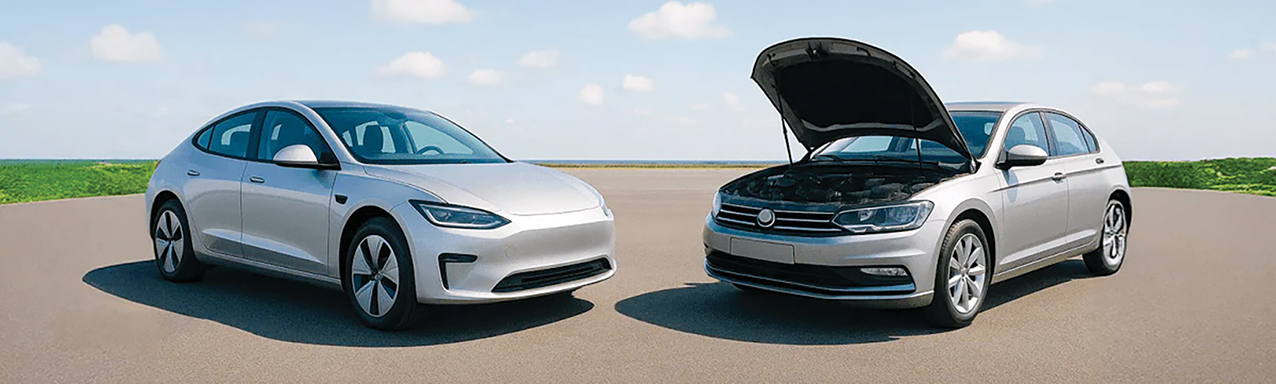
SHOULD EV’S BE AS REPAIRABLE AS ICE CARS?
Electric vehicles (EVs) should be just as easy to repair as traditional internal combustion engine (ICE) vehicles. That is the central argument made by the UK’s leading vehicle assessment body, Thatcham Research, in its New Electric Vehicle Blueprint released in recently. The organisation’s goal was to reduce the rising cost of insuring EVs, which is being driven in part by unnecessary vehicle write-offs – often caused by relatively minor damage that could potentially be repaired.
A major issue lies in the battery. In many EVs, the battery accounts for roughly 40% of the vehicle’s total value. Instead of replacing an entire battery after damage, Thatcham argues that more cost-effective repair options should be available. However, current vehicle designs often make this difficult. According to a survey conducted with the Centre for Economics and Business Research, battery-related concerns are the top issue for around 45% of insurers and 42% of repair professionals.
One of the main challenges is how battery packs are designed. Many manufacturers integrate batteries directly into the structure of the vehicle, often sealing them within welded or glued assemblies. While this can reduce weight and improve efficiency, it also makes repairs far more difficult. In some cases, individual components cannot even be removed, effectively turning the battery into a “throwaway” part.
Encouragingly, regulatory developments such as the EU Battery Passport are beginning to emphasise serviceability – the ability to access and maintain components – as a first step toward repairability. Improving serviceability would not only make repairs easier but also support recycling and remanufacturing efforts, extending the lifecycle of EV components.
Thatcham envisions a future where EV repair is as widespread and accessible as ICE vehicle repair is today. This includes the growth of independent and small-scale repair shops, which could fill a current gap in the market. Beyond economic benefits, EV repair work also offers a cleaner and more appealing environment for new technicians compared to traditional mechanical work, which has historically been associated with oil and grime.
However, there are still significant obstacles. Battery designs and key EV components vary widely between manufacturers, making standard repair practises difficult to establish. Some companies, like BMW, have taken steps toward repairability by designing battery systems with replaceable parts and training technicians accordingly. Others, such as BYD, use modular designs that make certain components easier to access and service.
Thatcham’s blueprint outlines several recommendations to address these challenges. It calls for standardised approaches to diagnosing high-voltage systems, reducing reliance on expensive specialised tools. It also emphasises the need for battery packs that can be safely disassembled using removable fasteners instead of permanent adhesives. Additionally, components like charge ports should be positioned in less vulnerable areas and designed as standalone units to simplify repairs.
Other proposed improvements include resettable safety systems that can be restored after an incident without requiring full replacement, as well as better methods for assessing battery damage. These changes would help insurers and repair shops avoid writing off vehicles unnecessarily.
While Thatcham does not advocate for heavy regulation, it does support some level of standardisation across the industry. Greater collaboration between automakers and organizations like Thatcham – especially during the early design stages – could ensure that repairability is built into future EV models from the outset. The organisation also plans to incorporate repairability into its vehicle risk ratings, helping to highlight which EVs are easier and more cost-effective to fix.
Industry analysts agree that these changes are both necessary and overdue. At Omedia, analysts note that in the race to develop EVs quickly and cost-effectively, some manufacturers may have shifted costs onto service networks, consumers, and recyclers. Designing vehicles with long-term maintenance in mind will be essential for achieving true parity with ICE vehicles – not just in performance, but also in ownership costs.
Examples of innovation already exist. In 2023, Stellantis partnered with battery-swapping company Ample to explore solutions that could extend battery life and simplify replacement and recycling processes.
Ultimately, improving EV repairability is about more than just reducing costs. As noted by analysts at Jato Dynamics, many consumers are unaware of how valuable EV batteries are. Writing off a vehicle after minor damage is neither economically nor environmentally sustainable. Thoughtful design changes could significantly improve affordability and sustainability over a vehicle’s lifetime.
However, achieving this vision will require global alignment. Different markets operate under varying regulatory, insurance, and economic conditions. For example, some regions prioritise rapid production and cost competitiveness over repairability. Addressing these differences will be key to creating a more consistent and sustainable global EV ecosystem.
In summary, Thatcham’s blueprint highlights a critical shift in thinking: EVs must be designed not just for performance and efficiency, but also for repair, longevity, and real-world ownership costs.