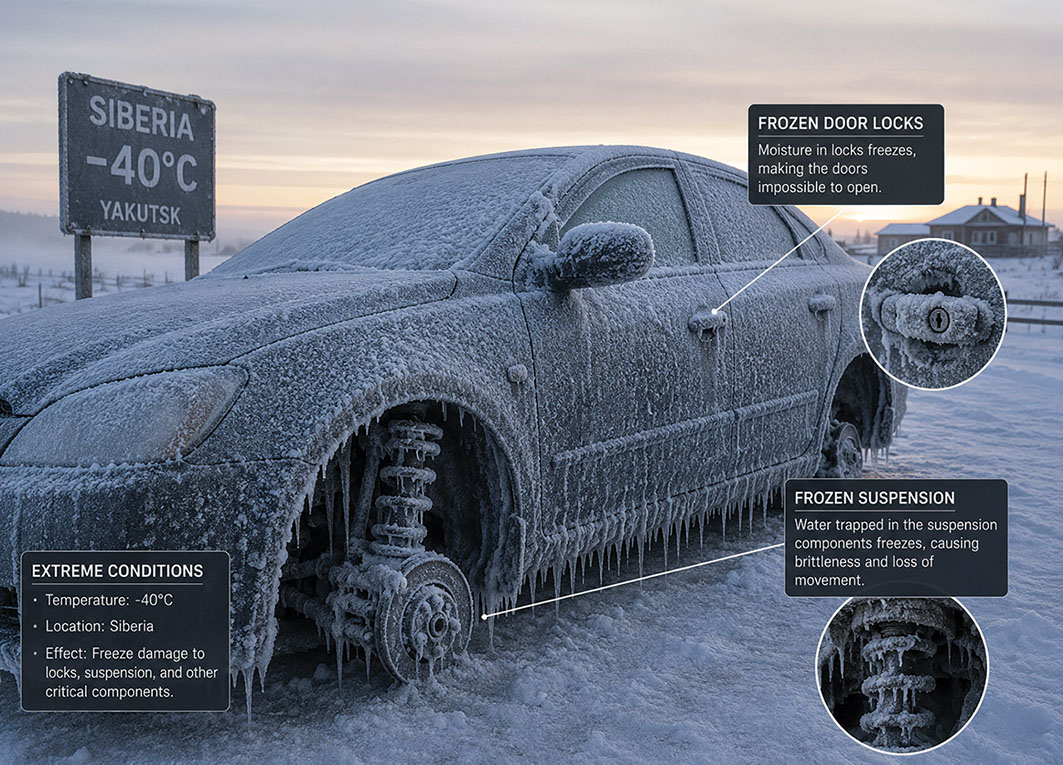
RUSSIAN CLIMATE EXPOSES CHINESE VEHICLE SHORTCOMINGS
Following the 2022 invasion of Ukraine, Western sanctions triggered an immediate exodus of iconic automotive brands. Volkswagen, BMW, Toyota, and Mercedes-Benz closed their production plants and halted all vehicle deliveries. This sudden retreat left a massive supply gap in the Russian automotive sector, reducing the market from a diverse array of global options to just 14 active brands.
Seizing this vacuum, Chinese automakers aggressively entered the region with cost-effective models. Within two years, the number of Chinese vehicles on Russian roads surged past 1.1 million, capturing a dominant 50% share of the new car market. Brands such as Haval, Chery, and Geely quickly filled dealership lots, enjoying a profitable, uncompetitive “sweet period” where consumer choices were severely limited.
The reality of the climate
The honeymoon phase collapsed as vehicles faced their first prolonged exposure to severe local winters. Fleet data and mechanical reports quickly exposed deep durability defects under harsh environmental conditions. The Russian Lamark Automobile Anti-corrosion Centre conducted a comprehensive study across 26 distinct regions, tracking the performance of 17 participating Chinese brands.
The findings revealed that many models lacked basic anti-corrosion treatments, causing metal parts to rust within just two years. For entry-level brands like JAC, Lifan, Jetour, and Dongfeng, visible corrosion appeared on body panels in less than 24 months. Even premium models from Haval, Geely, and Chery showed metal degradation after four to five years. In extreme subzero environments like Siberia, brand-new vehicles exhibited rust within six months. Furthermore, electric vehicle variants experienced rapid battery drain and severe power loss in freezing temperatures.
Generally speaking, the service life of new Chinese cars, under Russian conditions does not exceed 5-7 years, but there are also examples of cars being sold on the secondary market for more than 10 years that are still in use.
In contrast, European brands that have left the Russian market, such as Skoda, Opel, Peugeot, Volkswagen, Audi, BMW and Mercedes-Benz, show significantly higher corrosion resistance.
Rust is also one of the complaints Russian car owners have about Chinese cars.
Russian experts give maintenance advice to these Chinese cars that rust the fastest. Car owners who buy Chinese cars should immediately carry out anti-corrosion treatment after purchasing a new car and update it every two to three years. This measure can extend the service life by 10 to 12 years.
A survey by another agency, Othkrytie Avto, also claimed that 61% of Russians believe that Chinese cars are only partially adapted to local conditions, and 19% are convinced that Chinese cars cannot withstand the Russian winter at all.
Russians’ complaints about Chinese cars included: high prices, thin paint, soft suspension, poor quality of electronic equipment and obtaining spare parts, etc.
Fleet strain and structural failures
The most severe strain appeared in high-utility sectors such as the commercial taxi industry. According to reporting by the business newspaper Kommersant, Chinese vehicles rapidly climbed to make up 70% to 80% of domestic taxi fleets. However, fleet operators reported that these vehicles possessed a drastically reduced operational lifespan compared to legacy fleets.
Private owners mirrored these complaints, documenting widespread mechanical and structural issues:
Transmission Failures: Over 70% of surveyed owners reported severe issues with continuously variable transmissions (CVTs).
Electronics and Ergonomics: Drivers reported frequent failures in low-quality cabin electronics and poor seat ergonomics during long-distance travel.
Maintenance Costs: Analysts at the Russian National Agency for Industrial Information determined that maintaining a Chinese vehicle past five years of operation exceeds the market value of a brand-new vehicle.
Evgeny Zhitnukhin, head of the dealership department of the FRESH automobile marketplace, tells Russia’s Riamo online paper that many Chinese cars are not suited to the country’s climate – particularly electric cars, whose battery reserves may decrease rapidly in subzero temperatures. The number of complaints about Chinese cars’ performance in winter is high, despite recent above-normal temperatures.
Chinese cars also are susceptible to Russia’s cold weather which, combined with powerful snow-melting chemicals, damages paintwork and leads to corrosion. Another drawback is suspensions that can crack after as little as 43 500 miles (70 000 km) of use.
The logistics and parts crisis
Compounding the physical degradation of the vehicles is a severely bottlenecked supply chain. Data from the Russian Union of Auto Insurers shows that shipping times for genuine, imported Chinese components have doubled to roughly 45 days. This delay has flooded the secondary market with an influx of low-grade, counterfeit parts.
Industry specialists note that these logistical hurdles stem from corporate strategy. Roman Gulyaev, owner of the Euroauto repair network, observed that Chinese manufacturers heavily prioritise rapid factory assembly and vehicle sales over long-term infrastructure, leaving mechanics without necessary technical repair documentation.
Despite rising complaints regarding high initial prices and poor climate resilience, sales remain buoyed by cultural factors. For many local consumers, a car remains a vital status symbol, driving a persistent demand for brand-new models despite documented longevity flaws.
The high-quality and inexpensive repairs of Chinese cars will be difficult to achieve in the next few years due in part to the instability of the Russian rouble.
Still, some analysts note most of the Chinese cars sold in Russia are budget models costing several times less at home than they do in Russia. Selling those models in Russia automatically increases the price considerably due to various taxes, tariffs, fees and costs.