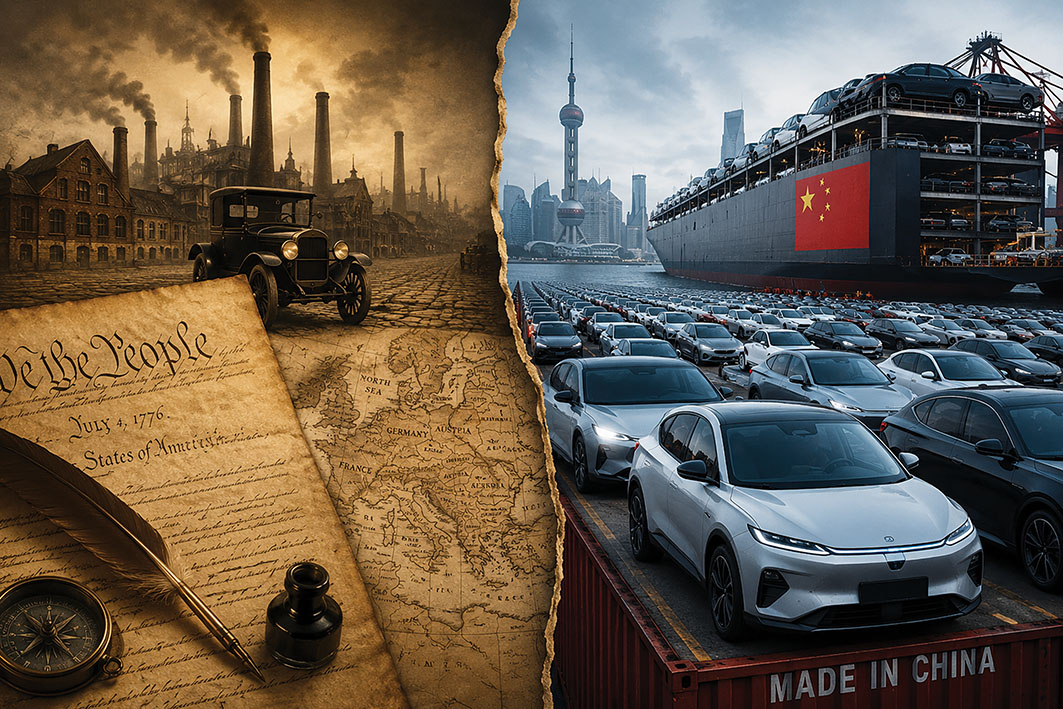
MUCH HAS CHANGED SINCE 1776
In a series of unintended consequences which can lead to automotive global market domination by China, what can we expect? Like many connected the UK, the USA seems to have unfinished business from long ago. Indeed, the 14th July 2026 marks the 250th anniversary of the Declaration of Independence. Much has changed since 1776…
Often, we don’t appreciate what’s on our own doorstep – I live 15 miles from Stratford-upon-Avon where William Shakespeare was born and wrote many fine works. For-strewth, (I think that’s a Shakespearian term) I don’t visit very often and have seen a play once in the last decade. Familiarity and all that.
Right now, the European vehicle manufacturing companies are considering lopping off entire limbs one by one (‘Tis but a scratch!’, copyright Monte Python and the Holy Grail) and the red stuff gushes from the financial statements. Why?
Chasing the dragon
A long time ago the European manufacturers had multiple booming markets and a steady global demand for product. As is often the case the manufacturers did not follow the wise business model of Enzo Ferrari – precisely less product than the demand, always – and decided big, bigger and vast was the way forward. Hence Citroen building thousands of Wankel engines without a single customer for two years. That kind of madness.
The factory space became an emblem, and by the 1990s one third or so of all activity could fit into the un-used factory space. That unused space was not free, and it came with employees. Fortune shined and the problem was eventually addressed in the depths of the 2008 financial crisis – there was no choice – and has been ever since. Some plants were relatively empty, but until 2023 most were running at between 67 and 90 percent capacity.
This did not address relatively high wages nor, thanks to the love of President Jo Biden, the loss of inexpensive natural gas which led directly to some of the highest energy costs in the world.
Meanwhile the overnight success of China, 40 years in the making, stirred. With plant utilisation running at around 50 percent and a ruinous internal market price war, export was the only route to salvation. They had no choice.
So, China can land vehicles with or without import duties ‘fully loaded’ at prices that undercut the European manufacturers. The trimming that has gone on since 2008 was undone overnight, as the EU27 Commission and Parliament decided to have meetings to discuss meetings about meetings. In just over a year, and the prospect that things are not going well, this has happened:
Stellantis offered Brampton in Canada CKD build of Leapmotor models, the China manufacturer they invested in. Brampton has not worked since 2023 and said ‘no’ since that eliminated the body and paint shops.
Stellantis are offering around four plants in Europe, in Spain and Italy, as possible sites for China manufacturers. The logic? If staff are axed, it won’t be Stellantis doing it.
Stellantis at the very same time have removed 650 engineer jobs from Opel, about one third of the present head count. That’s pretty alarming – deleting your own engineers to invite engineers in from an associate company.
Volkswagen are making the same overtures to major China manufacturers, with the same intent of not being held accountable for job losses. ‘Tis but a scratch!’
Short termism
The idea that cutting plants to then hand them over complete with ‘technology transfer’, as China repeatedly claims it is the ‘best in the world’ and the ‘most advanced in the world’ beggars’ belief.
In two years, new vehicle imports from China to EU27 and UK have gone from a fraction of a percent to around 10 percent. This is because the China automotive sector has to find ways to charge more for their products and export is the only way forward. In a significant misreading of the politics, it would appear Stellantis and Volkswagen Group would rather roll out the red carpet than earn market share.
The automotive sector and especially the collision repair business faces being eaten alive unless our governments and business leaders start to really think. Already from Germany alone there have been 350 000 automotive manufacturing jobs lost, with the prospect of at least that number again by 2030. By taking into account the jobs in companies making parts, which has been underway since 2018, the sector is already past the first million jobs.
For China the objective is to dominate the market, and to supply a lot of new cars to the world in order to use up the present domestic manufacturing capacity of 25 million vehicles per year, and the planned 55 million units per year.
• China has no reason to engage with governments about:
• Local content laws
• Local assembly/manufacturing
• Provision of parts for repair.
Thanks to the European manufacturers thinking they can invite China manufacturers to help them out but failing to realise once they are inside, they are not leaving; this is not like the China market of the 1990s. Instead, Europe faces circa 30 percent of all new vehicles sold in EU27 plus UK coming directly from China with or without import duties well before 2030.
Best not disturb the European governments as they sleep at the wheel.
What does market domination look like?
The biggest mistakes the European automotive companies have done so far are:
Rushed product development for BEV, PHEV, HEV and MHEV powertrains. This was in part due to government appearing to want all these options and then as product came to market, decided BEVs were the only way forward. So, reliability suffered.
Energy costs rose, greatly aided by President Biden’s administration deciding to blow up Nordstream 1 and Nordstream 2 natural gas pipelines. How so very 1776.
Of course, Net Zero has also added significantly to energy costs.
The automotive companies fell in love with China market style, failing to realise that China was very good at that by 2019 and if they wanted foreign vehicles at all, they had to be stylish. Meanwhile the rest of the world is puzzling why we have to buy cars with illuminated external badges and interior lighting akin to certain types of late-night clubs.
The European manufacturers assumed China companies do business the same way. They don’t.
Aside from the many mis-steps Europe and especially the German auto industry will not face up to the China domestic market has closed to them, for the time being. Watching sales numbers, brand after brand collapse between 2024 and 2025 was incredible.
All of this is what Australia went through when the domestic automotive manufacturing business collapsed – not just the providers of complete vehicles but many specialist companies too. That’s what is underway in Europe now.
So, as repairers clamour for any information about any China made vehicle – which is straight business after all – there is almost no recognition of what could happen if the China manufacturers end up supplying 60 or 70 percent of the market by 2035.
• No repair parts
• Vehicles shipped back to China for repair or destruction.
• A massive change to the collision repair business.
The bottom line
The European vehicle manufacturer ‘execs on expenses, appear not to understand as they axe their own company production capacity, it re-appears as China dominates market after market. Those same leaders think the most they can do is massage the monthly financials, and, so have decided to be pro-active by doing very little (copyright MG Rover, RIP).
So, those same executives court Chinese companies because the EU Commission is ‘bound’ to insist on local content laws, so they’ll need factories … except the rolling five-year plan in China see’s none of this.
If China will dominate in Europe, ‘cheap’ new cars will disappear given the lack of competition. In the same way parts supply can go and whistle Dixi because … domination means not having to comply with other countries rules. Similarly, domination means turning export markets into cash cows to be milked for every last cent.
Look at the effect of ‘free trade’ (which it isn’t) as Brazil opened its market to China imports to find a massive influx of imports and decimation of their automotive manufacturing sector. Brazil now realises the mistake, but the problems are already huge. Europe is already importing way more vehicles that Brazil.
Many European collision repairers do not know what’s coming. Australia does. You’ve been here since at least 2014/15 or so.
Every previous ‘threat’ from Japan and South Korea ended up with collaboration, domestic market assembly as well as locally made parts. Parts that are easier to get for collision repair if they happen to be made in the same country, or region in the case of Europe.
I’m not convinced this is possible with China.
Let’s act to protect the collision repair business now, so major international companies are not able to sweep in, take and leave nothing behind.
By Andrew Marsh