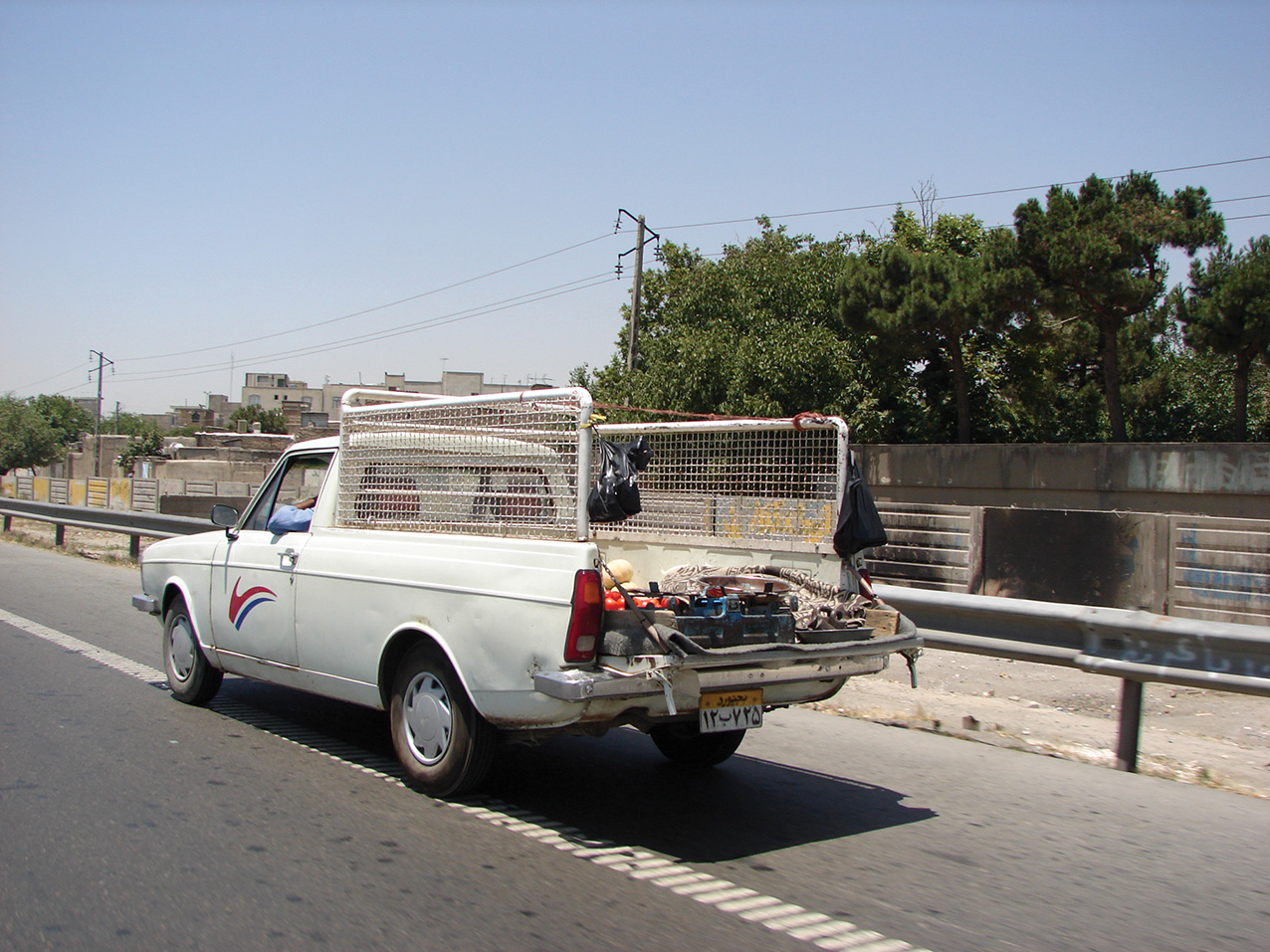
IRAN ONCE HAD A HUGE NATIONAL MOTOR INDUSTRY
Iran has been very much a closed-door country to most of the world’s population for the past 45 years. One of the little-known facts about this country is the extent of its nationalised automotive industry. Due to sanctions and a focus on nationalisation of industry Iran had developed a strong local industry for the past six decades. However, these factories have evidently been bombed in the ongoing conflict in the country where industrial infrastructure has been a prime target. The Iranian vehicle manufacturing industry was ranked the 17th largest vehicle producing country in the world in 2024 and the 1.1 million vehicles it made was 85 000 more than the British motor industry produced that year!
Production in 2025 again amounted to production of more than a million new vehicles, with most of them (75%) being cars, with the next most popular segment being pick-up trucks with a 15% market share.
The country has a vehicle parc of about seven million cars, trucks, and buses and eight million motorcycles, with the latter said to be responsible for 30% of the air pollution in Tehran. Iran has also developed a vast network of component suppliers for both vehicle production and the aftermarket.
The door was opened in July 2024 for the introduction into Iran of used vehicles, mainly from Japan and Korea, but also from some European countries.
The country aims for 80% of its new vehicles to be produced locally, while there is a growing number of Chinese brands importing cars, while some vehicles from well-known brands such as Toyota, Land Cruisers still find their way into the country on circuitous routes from legitimate importers in the region to beat the sanctions.
The desire for localisation has resulted in several models being licensed for manufacture in Iran where they are given their own names. These models were also then updated locally down the years. Iran Khodro (IKCO) and Saipa are the two main manufacturers, both nationalised.
European car makers, Renault and Fiat, were the first OEMs to set up assembly plants in Iran. This was in the 1960s. However, local manufacture took a big leap forward when the Khayami brothers, two Iranian entrepreneurs, did a deal in 1966 with the British Rootes Group to assemble its Hillman Arrow series of cars from completely knocked-down kits imported from the UK.
The cars were given the name Paykan in Iran, with the name derived from the word “peykan,” which is Iranian for “arrow.” The Paykan subsequently became Iran’s national car for many decades.
Construction of the original factories was supervised by British employees from Rootes Group and Brits also provided training for the factory workers. The cars got significant tax concessions and were far cheaper than cars such as the Volkswagen Beetle and Fiat 1100, which were sold there at the time. Initial volume was 15 000 Paykans a year, which resulted in long waiting lists.
The Iranian rulers soon instituted major localisation programmes to increase production, and the cars were significantly improved during the long period they were produced. The original Hillman Hunter-based Paykan was run out in 1979 when the Shah of Iran was overthrown and the factories taken over as part of Iran’s Islamic Revolution.
The British link may have been broken, but the Paykan cars soldiered on until 2005 as a homegrown product built by IKCO. During the Paykan’s life its original 1725 cc Rootes engine was replaced by a 1600 cc Peugeot 504 power unit, because during this time the Rootes Group had been acquired by Peugeot and renamed Talbot.
A pick-up truck, based on the Hillman Hunter and known as the Bardo, was introduced to the range as early as 1969 and continued, unbelievably, until 2015 – a period of 45 years! The Paykan bakkie was built and sold in South Africa, badged as the Dodge Husky, for a short period before Chrysler South Africa merged with Anglo American’s automotive interests to form Sigma Motor Corporation.
There should have been a change in the national car in 1979, but the revolution put paid to that with the new Peugeot 305 to have taken over the title of Iran’s national car. Finally, in 1990, at the conclusion of a war between Iran and Iraq, the country received a new car from its partner, Peugeot. This time it was the 405.
After the Peugeot 405 had been in production for a decade it was transformed into what was hailed as the first truly Iranian car, and the spiritual successor to the Paykan, which remained in production until 2005. The new car was named the IKCO Samand.
Many other car makers were attracted to Iran over the years and in 2001, there were 13 public and privately owned vehicle manufacturers in Iran, but 94% of sales were taken up by IKCO and Saipa, which were still 40% owned by the state.
Nowadays there are a host of different brands on sale in Iran, including imports from China. However, the many sub brands from IKCO and Saipa still lead the popularity stakes, with IKCO using various Peugeot components, while Saipa has built a successful range of cars, using the Kia Pride from the late 1980s as the original base. IKCO is, in fact, the largest vehicle manufacturer in the Middle East, although government subsidies and tax breaks obviously play a role in this situation.
By Roger Houghton