INVESTIGATING VEHICLE WRITE-OFFS IN THE UK
As vehicle technology becomes more advanced and repair costs continue to rise, increasing numbers of cars across the UK are being written off following relatively minor accidents. Why are the write-offs increasing, what is the impact of repair volumes and consumers, and how is the trend reshaping the salvage and repair industry?
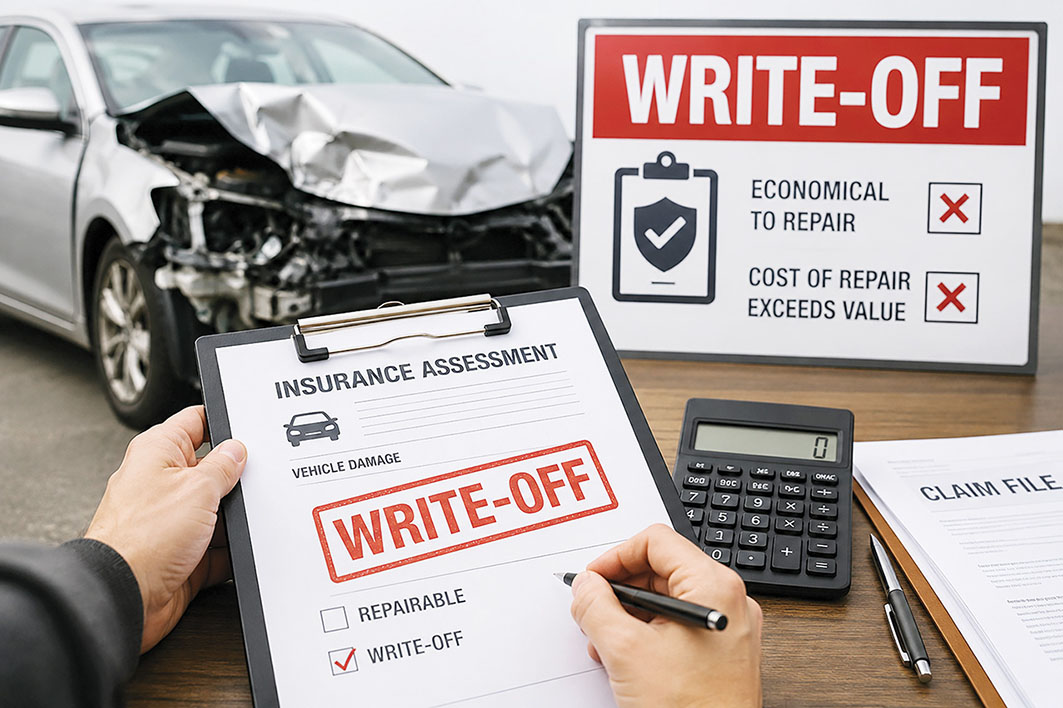
The number of vehicle write-offs in the UK has increased in recent years, with several factors driving the trend. Repair costs have surged, and modern cars are much more complex. A small bump that once required a simple panel repair can now require calibration of sensors and replacement of expensive electronic parts so that insurers often decide it’s not economical to repair.
We are seeing a clear and sustained increase in vehicles being deemed uneconomic to repair across the UK market and this is being driven by a combination of rising labour rates, increasing parts costs, and the complexity of modern vehicles, particularly those with advanced driver systems (ADAS). What we are seeing especially is growth in so-called ‘borderline’ total losses These are vehicles that historically would have been repaired but are now tipping over the economic threshold. The salvage pool contains more cosmetically damaged, drivable cars (Cat Ns) than it did previously.
Industry estimates suggest there were 1.75 to 1.85 million vehicle insurance write-offs in the UK in 2025. If repair costs approach 50-79% of vehicle value, insurers often write it off, but write-off thresholds can vary. A vehicle that may be treated as borderline repair in one route can sometimes be pushed more quickly towards total loss in another, depending on the claim type, the commercial model behind it, and how the overall costs are being assessed. While the industry often talks about write-offs as though there is one consistent approach, in practice, there can be noticeable variation. Manufacturer borderline programmes can. Be useful where available, particularly when they help keep a repair within reach that might otherwise tip into total loss. In general, anything that supports safe repair retention is helpful, but consistency across the market remains a challenge.
Although many borderline vehicles are technically repairable, the challenge is making the economics work. Writing off a vehicle can reduce claims costs and therefore help to keep motor insurance premiums lower. Equally, in times of financial hardship due to economic conditions, some motorists may be more pre-disposed to accepting a total loss cash settlement. However, cash settlements are not necessarily the fairest solution.
In a cost-of-living environment, cash can become an incentive in itself. A customer may accept a total loss settlement because the immediate cash is useful, not necessarily because it delivers the best long-term outcome. Acceptance should not automatically be treated as fairness. If the settlement does not allow the customer to buy a genuinely comparable replacement, then the write-off decision may leave them worse off in practical terms, even where the valuation process appears to have been followed.
Inevitably total losses impact on work volumes because every vehicle written off is work removed from the repair sector. The real question is not simply whether a vehicle can be written off, but whether it should be and whether the decision has been made with enough technical input at the right stage. Ideally potential total losses should be identified early, but the final position should be informed by proper repair knowledge, not purely by remote cost triggers or headline economics.
With an ageing UK car parc, more vehicles are likely to sit close to the economic write-off threshold. An older vehicle may still be reliable, familiar and an affordable asset for the customer. The question should not only be whether the vehicle is economic to repair on paper, but whether the customer can realistically purchase a like-for-like replacement after the total loss settlement.
The borderline total loss decisions should be viewed through a customer outcome lens, not only a claims-cost lens. Customer should receive clear explanations, fair treatment and outcomes that can be evidenced. Where a vehicle is technically repairable, there should be a clear record of whether repair-preservation options, recycled parts, manufacturer support or proper repairer input were considered before the vehicle was written off.
Several vehicle manufacturers operate total loss avoidance schemes when repair cost narrowly exceed the insurance company’s threshold. The BMW/Mini Borderline programme has been running for over seven years and historically operated as a reactive programme. Since 2023 it has evolved into a proactive programme and saved over a thousand vehicles, keeping these vehicles within the BMW/MINI Ecosystem.
The process is straightforward. Once a body shop is enrolled into the BMW Borderline programme, the system automatically intercepts estimates from both Audatex and GT Motive, issuing support offers for those that meet the relevant criteria and thresholds. Estimates that fall close to the qualifying parameters trigger an email notification, advising the body shop on the actions required to become eligible for additional support.
Once an offer is accepted by the body shop and authorised, the details are shared with the supplying parts retailer who will provide the parts to the body shop at a discounted price, making the process of sourcing and purchasing parts quick and efficient. At all times, there are agents on hand to support the body shops through the process to answer any questions they may have.
Volkswagen Group’s Total Loss Avoidance (TLA) Programme (with TPS) has been running since 2014 and has evolved several times to become the programme it is today. Last year it saved just under 4 000 vehicles. The team will respond to requests within 30 minutes of receipt of the assessment and email a quote to both the parts team and the VDA at the body shop.
It is really simple; once the body shop signs up, they will receive the relevant data from the Audatex or GT Motive assessment, and their system will identify any borderline vehicles for their Parts Sales Executive to review. If they chose to, they would apply further discount to the entire parts basket, including EV batteries, and if accepted by the customer they will invoice that price, which saves them from additional paperwork to claim discounts or rebates. Although it is mostly body shops who contact them because they receive the assessment data, they are keen to work with insurers to try and save those vehicles that are triaged straight to salvage.
VRA certified high-quality graded recycled OEM parts can also play a significant role in reducing repair bills, speeding up and reducing credit hire bills, and even come with a warranty. The idea is to focus on delivering consistency and confidence, ensuring that recycled parts are not seen as a compromise, but as a reliable professional solution that supports both commercial and sustainability goals. Investing in bespoke technology so that real time parts availability and cost can be integrated into body shops’ estimating systems, enabling recycled parts to automatically be a realistic option at the very start of the repair process: saving body shops parts sourcing time while boosting workshop productivity.
For insurers the use of recycled parts can avoid the need to total loss a vehicle, boosting customer satisfaction and strengthening customer retention; removing the acquisition cost of replacing the customer whilst at the same time support ESG strategies and carbon reduction targets; so, seeing sustainability and recycled parts become central to mainstream claims strategy.
Another reason why write-offs are increasing is that insurers are facing increasing pressure from claims inflation. In 2025, they paid out a staggering £11.9 billion in motor claims, almost two thirds of which related to vehicle damage. Whilst claim volumes have fallen, no doubt aided by an increase in higher excess levels, claim values continue to escalate. Ancillary claims costs, in particular credit hire, continue to experience unprecedented inflation and when combined with prolonged hire duration cause further financial impact. Growth in EVs is pivotal here too, as they take longer to repair and require more expensive rental cars. An effective balance has to be found. For insurers, routing a vehicle that is borderline total loss has to be determined by cost and recovery opportunities linked to the options of repair versus salvage versus resale.
As EV numbers ride, Category S and N write-offs increase, because battery damage can be difficult and expensive to assess and even minor impacts can trigger full battery replacement which will then incur the cost of disposal of the original assembly. EVs can be more susceptible to being written off mainly because of the added sensitivity around battery systems, uncertainty around hidden damage, and the relationship between repair cost and vehicle value. That does not mean they are less repairable in a physical sense, but it can mean they fall into total loss territory more quickly if the process is cautious or the economics become stretched.
Secondhand EVs are reshaping salvage economics. Battery handling is complex and costly, and the secondary market for EV parts is, as yet, immature. We are really seeing a growing volume of electric and hybrid vehicles entering the salvage and breakers stream – an 80% increase between January 2025 and 2026, in fact. This reflects both increased adoption over recent years and the natural maturation of the parc.
Caution around EV batteries
While the industry is gaining confidence in handling electric vehicles, there is still a degree of caution, particularly around battery assessment and repair protocols. Mileage alone is an unreliable indicator of battery condition. Younger high-mileage vehicles can often outperform older low-mileage equivalents, depending on usage and charging behaviour.
The battery monitoring system is the most important thing to check. Is it alive, what is it doing, what is the status of the cooling system and has the battery assembly got coolant? If the cooling system has been drained as a result of impact damage, the traction battery will need very careful assessment. If any cell within the battery, is either less able or more able to store energy so does not perform identically to the others, it will get hotter during charging and discharging. The user won’t notice but if any cell within the battery assembly is continuously overloaded, it increases the risk of thermal runaway. That’s why matching the performance of the cells is very important, along with finding out how much of the BMS function will usually require the 12 system to be functional, even if it’s drawing energy from the high voltage (HV) battery.
The next step is to look on the other side for scarring. The vehicle doesn’t often stop in the first impact, it can carry on, typically going over structures on the road, obstacles, or central reservations, and the moment it does that, because the lowest point of the vehicle – especially for BEVs – is the battery pack between the front and rear wheels, that’s where we get scarring. Most HV batteries have very little internal space to absorb impact, so causing permanent deformation on the lower case will have compressed the outer cells internally. The internal battery cell cooling system is often just above the lower case of the battery assembly. Som the biggest key for assessment is to see that the case does not have significant underside scars, the cooling/heating system remains functional, and the body has protected the rest of the battery assembly.
For BEV users care is vital. Abuse is the equivalent of someone always running an internal combustion engine at maximum speed. Exclusive use of rapid charging beyond vehicle manufacturer guidelines and rapid acceleration will have a negative effect on battery health. The most common way significant range degradation occurs is through system abuse – most HV systems on sale since at least 2015 have been far more reliable than the earliest HV Li-ion battery-based system. Premature battery energy storage retention failure will lead to a conversation with the insurer or warranty provider. The HV battery monitoring systems are continuously evolving, and some may not give enough information to decide if the unit was damaged as a result of impact or if it has pre-existing damage. Expertise is available to help with this decision. However, the overall problem directly affects the body shop business because if the decision to repair or replace the assembly proves to be incorrect, they could carry the liability. So, approaching rapidly, body shops will have to be able to interrogate the BMS, understand the consequences of external damage indicators and know what’s inside the battery case.
To help address the growing challenge of electric vehicle insurability and repair costs, Thatcham Research launched a blueprint aiming to prevent a growing number of electrical vehicles from being unnecessarily being written off each year.
The EV blueprint shows that instead of replacing a battery that can represent 40% of the car’s total value, it could be economically repaired – keeping EVs over three-years-old on the road and out of the scrapyard. Even minor collision damage can result in total loss determinations, particularly as vehicles depreciate over time. The framework addresses two fundamental challenges: post-collision diagnosis and assessment, and post-collision repair execution. By tackling these issues, the blueprint aims to reduce total loss rates, improve salvage and residual values and ultimately influence insurance premium structures positively. Ultimately, the blueprint represents a critical step towards making EV ownership more sustainable and economically viable.
Fault and non-fault accidents can influence decisions
Another influence in write-off decisions is sometimes the variance between fault and non-fault assessments. Sometimes this is influenced as much by consumer behaviour as by the damage itself. The fault status can show how the claim is handled, how costs are viewed, how quickly decisions are made, and how willing the customer may be to proceed with repair. That can create different outcomes for vehicles that may not be materially different in repair terms, but which are being processed through different commercial and behavioural routes.In terms of wider trends, more could be done to save vehicles from total loss. In some cases where cars are technically repairable, but the surrounding process, cost structure or route of handling makes repair less likely. Early repairer input, better alignment between assessment and real repair capability, and greater focus on repair preservation would all help. A decision that may appear efficient on paper can still damage a trust if the customer believes their vehicle could and should have been repaired. The cost of serving an existing policyholder well should be weighed against the wider cost of dissatisfaction, lost renewal and having to acquire a replacement customer.