IN SEARCH OF NUGGETS AT THE GEORGE OLD CAR SHOW
One of the best parts of the George Old Car Show – or any car show for that matter – is the nuggets you find tucked away in the more obscure sectors. For me, the highlights of the show ranged from iconic motorcycles to unusual versions of common-or-garden classics that you would expect to see in great numbers, and exotics that turned up unexpectedly.
Let’s take a look at few of these that graced the 2026 event, held as usual at the technical college in York Street, the main drag of the city that is often referred to as South Africa’s Garden of Eden.
1968 Vincent Godet Sport GT 1300 Motorcycle
This bike punched so far above its weight in the late 1960s that it is quite amazing to realise it came from the same era as the defining motorcycle of its time, the Honda CB750 four-cylinder. The stock Vincent Sport GT had a top speed of 222 km/h in “normal” form, while the Godet version of the V-Twin shown in George was rated at 240! This was in the era when the Honda was feted word-wide for its top speed of just on 200 km/h.
1954 Vincent Black Shadow
Again, the world’s quickest production bike of its time. A similar V-Twin model, a suitably stripped-down Black Lightening, was ridden by a certain Vic Proctor, lying completely prone on the saddle with his legs and feet extended out behind, at Verneuk Pan in the Northern Cape. The fearless Capetonian set an overall South African land speed record of 149 mph (around 240 km/h) in the very early 1950s, which stood for nearly two decades before another South African hero, Bobby Olthoff raised the bar in late 1967 to 179 mph in his McLaren Elva Ford sports racer. Proctor’s Black Shadow record, it should be noted, stood for 45 years in the SA two-wheeled land speed record category.
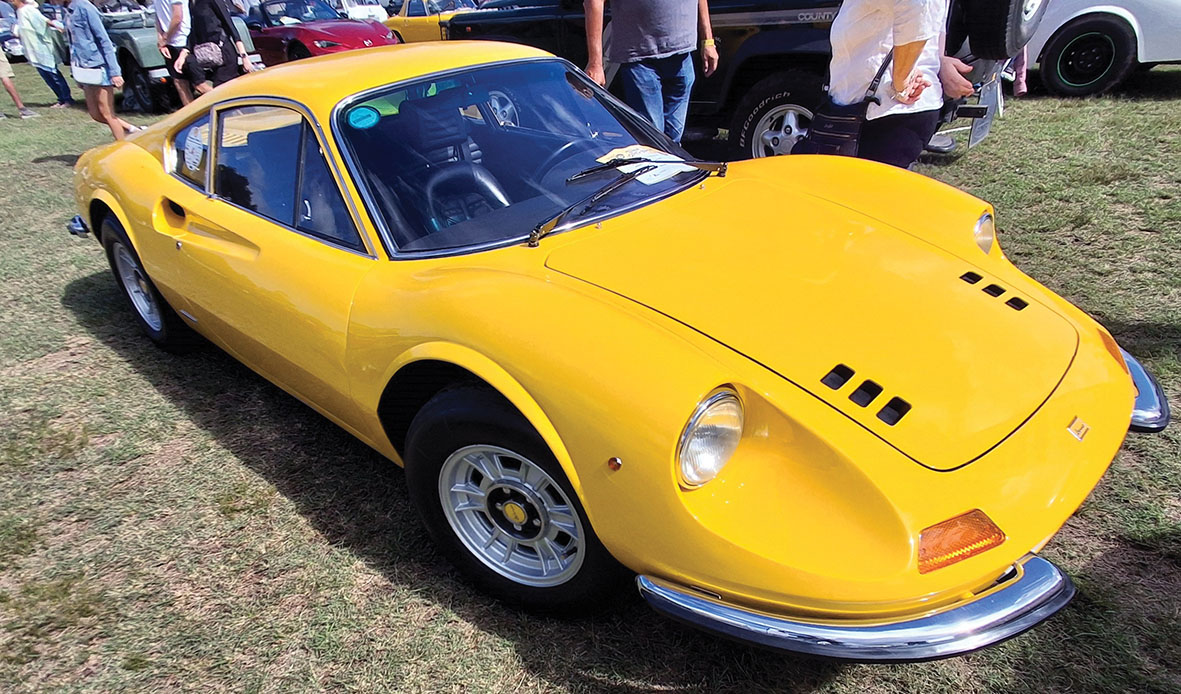
Dino 246
Everyone knows it’s a little Ferrari, but for some obscure reason the exterior and interior of this V6 Maranello marvel bears no evidence of the name “Ferrari” or the iconic prancing horse badge. More and more, the wieldy Dino 246 with its marvelous-sounding small-capacity V6, is becoming one of the classic Ferraris to own, not quite up there with the likes of the Daytona or the Boxer yet but getting there!
Porsche 356B Cabriolet
Any Porsche is a great car – with the possible exceptions of some of the SUV models and the 914 Volks-Porsche of the ‘70s (although the 914 and 916 are finally being accorded the proper respect they deserve). But you’d have to go a long way to match the likes of a 356B in cabriolet form for sheer elegance and beauty. Tammy Hargreaves from Port Elizabeth who has owned notable classics like the Bertone styled Alfa Romeo GTV2000, is definitely on the same page as us!
Ford Anglia Van
Anglias are a dime a dozen (although they remain one of my personal all-time favourites) but vans are as rare as an uncomfortable Lazy Boy recliner (that’s a chair, dude!) The one in George this year (the car, okay, van) was weirdly customized, but it was cool, nevertheless.
Ford Model T
The major theme of this year’s show was cars through the ages from 1886 to right now. The car that put America on wheels was the Model T Ford built from 1908 to 1927, and Henry Ford’s amazing invention sold across the planet too, to the tune of over 15-million examples. A couple still enjoying their Model Ts immensely today (they have three of them) are Phillip and Amanda Rosser.
1930s DKW F-Series
Anyone who reads my stuff regularly will know I have a soft spot for DKW two strokes. But very few people realise that these two-stroke cars were built well before World War Two, and one of these is this little twin-cylinder two stroke sporty model, known as the F series in various iterations. Like all Deeks, it has front-wheel-drive too.
Volvo 144, 1968-1972
A Volvo 144 as a nugget? One of the most boring Volvos ever? Well, Howard Bates’ sea-green example not only has a brace of Weber 42 mm DCOE side-draught carbs (the hot performance ticket of the 1960s and 1970s) but it has lapped the Nürburgring Nordschelife and driven to untold places on the European continent too. Check out the automotive CV on the passenger door!
MG TC, 1945 to 1950
After World War Two, American servicemen stationed in the UK were exposed to an amazingly affordable, fun and exciting sports car that was tiny by American standards, and hence more fun than anything available on the American market at the time. That car was the MG TC, with a diminutive but characterful four-cylinder engine displacing under 1300 cc that was perfectly suited to this machine with its spindly wire-spoke wheels and its guarantee of wind-in-the face motoring Ð a four-wheel motorcycle, in other words.
The American demand for the TC established the MG brand as a global icon, and hundreds of TCs were sold here in South Africa too. This was the template for a whole series of MGs that followed through the next two and half decades, making it the archetypal British sports car until well into the 1980s!
Sunbeam Rapier 1958 to 1963
In the late 1950s until the early 1960s, one of the cars to own was a Sunbeam Rapier. This was particularly true if you had any aspirations as a rally driver, thanks to its sturdy construction, strong performance from its twin-carb four-cylinder Rootes engine and a dashboard that had all the right gauges. These just included a rev counter, in an era when most British cars had a speedometer and a couple of warning lights for vital signs such as water temperature and oil pressure. This example at the 2026 George Old Car Show was appropriately decked out with spot lamps, headlight stone guards, aftermarket rally-spec wheels and an array of rally orientated decals, stripes and competition numbers.
Story and pics by Stuart Johnston