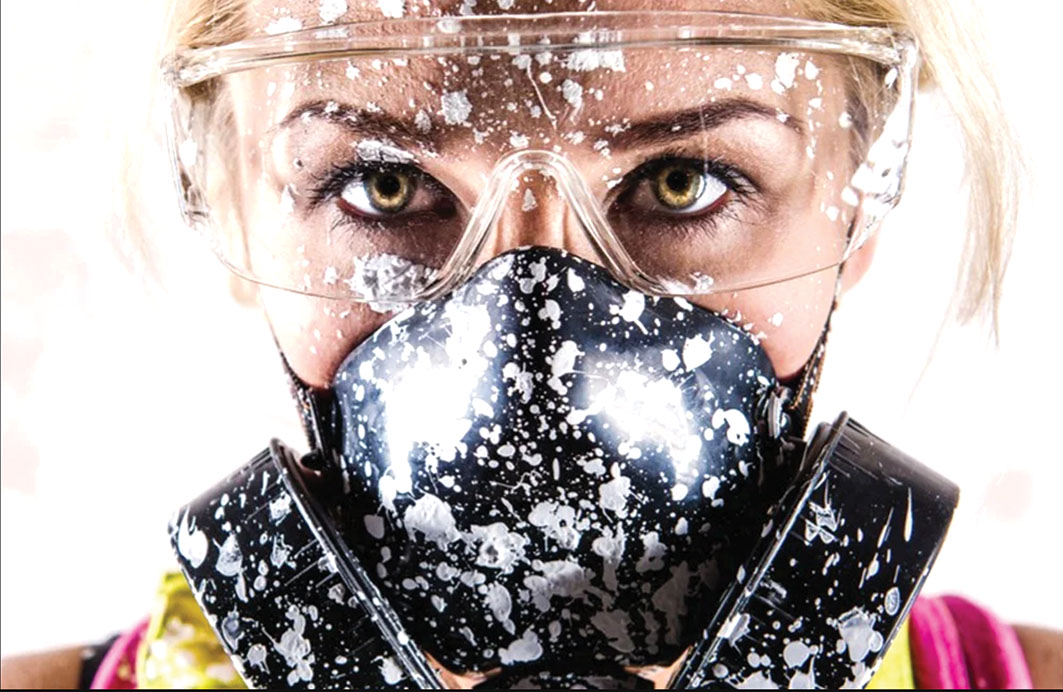
ILL-FITTING MASKS POSE A SERIOUS HEALTH RISK
Paint technicians in the automotive aftermarket are 90 times more likely to get asthma than the general population, while figures from the Health and Safety Executive reveal that about 50 painters are diagnosed with occupational asthma every year.
In most cases, they are forced to leave the industry because, warns the HSE, “once a worker has been sensitised, even tiny amounts of exposure can trigger an asthma attack.”
Body shop painters are particularly vulnerable to occupation asthma – otherwise known as operational asthma – because of the risks of breathing in isocyanates, which are used in some water-based paints, most basecoats and almost all lacquers.
The HSE said, “Using isocyanates is one of the main causes of occupation asthma reported in the UK and, for years, vehicle paint sprayers have been the group most are risk because paints containing isocyanate are used extensively in motor vehicle repair as almost all body shops use isocyanate-containing paints.”
Risk
The challenge is that these risks are often overlooked or misunderstood. Many of those working within body shops believe that a clean air supply to the spraybooth provides sufficient protection.
But that is only as effective as the mask’s seal against the face, and if there are any gaps around the edges of the mask, dirty air will pass through them and into the paint technicians’ lungs.
The HSE said, “Respiratory protective equipment (RPE) can’t protect the wearer if it leaks. A major cause of leaks is poor fit. People come in all sorts of shapes and sizes and it is unlikely that one type or size of RPE facepiece will fit everyone, so fit testing is critical to ensure that the equipment selected is suitable for the wearer.
Beards
The issue becomes even more complex if the paint technician has facial hair. This does not just mean a beard, as even a few days’ stubble can have a significantly negative impact on the effectiveness of a mask’s seal.
A government study into the effect facial hair has on mask seals stated that: “Protection could be significantly reduced where stubble was present, beginning within 24 hours from shaving, and generally worsening as facial hair grew.”
That view was echoed by training and Testing Services, which specialise in face masks and one of the few training companies in the UK to be accredited by the British Abrasives Foundation.
It said, “In order to achieve the best levels of protection, we strongly advice that employees are clean shaven in the areas of the seal. Alongside moustaches and sideburns, beards and interfere with the initial testing process as well as the day-to-day protection of close or tight fitting RPE.
“Some people chose to grow beards for religious reasons or a medical condition, and this type of facial hair can pose a problem for those working in jobs that require the use of RPE.
Different forms of respiratory protective equipment can be used, such as hoods, but the consensus is the less hair, the better.
Dust Masks Direct, which specialises in personal protective equipment products, has drawn similar conclusions. It said: “The compatibility of beards and masks is a question we get asked more often than anything else and, putting it bluntly, facial hair and tight-fighting respirator marks just don’t mix.
“The simple fact is that no dust mask can work effectively unless it forms a seal against the skin. Facial hair can create gaps between the respirator and the skin, thus breaking the seal and leaving you unprotected from hazardous materials and breaking every health and safety law in the book.
Responsibility
While there is an individual responsibility to personal safety, the legal responsibility rests with the employer.
The HSE concluded: “Employers have a legal duty to ensure that all paint sprayers have successfully completed the required training before using isocyanate paints. Due to the high hazard nature of isocyanate containing materials, training needs to be robust and suitable to the hazard presented.
“Information, instruction and training is not a one-off exercise and should be reviewed and updated whenever significant changes are made to the type of work carried out or to the work methods used. Training should also be repeated at least every five years.”
Key safety tips
- Never spray paint outside the spray booth.
- Never lift your mask to check the quality of the work while in the spray booth.
- The spray booth takes time to clear; measure it with a fog generator and clearly mark it on the entrance door.
- Always wear respiratory protective equipment when spraying.
- Make sure the booth runs at a slight negative pressure so in the event of leaks, air is drawn into the booth rather than leaking out into the workshop.
- Carry out daily and weekly checks and record findings.
- Carry out regular health assessments such as lung function testing and skin checks to identify early symptoms and signs of occupational asthma.
- Ensure controls are working by measuring employee’s exposure to isocyanate by taking urine samples.