DID YOU KNOW?
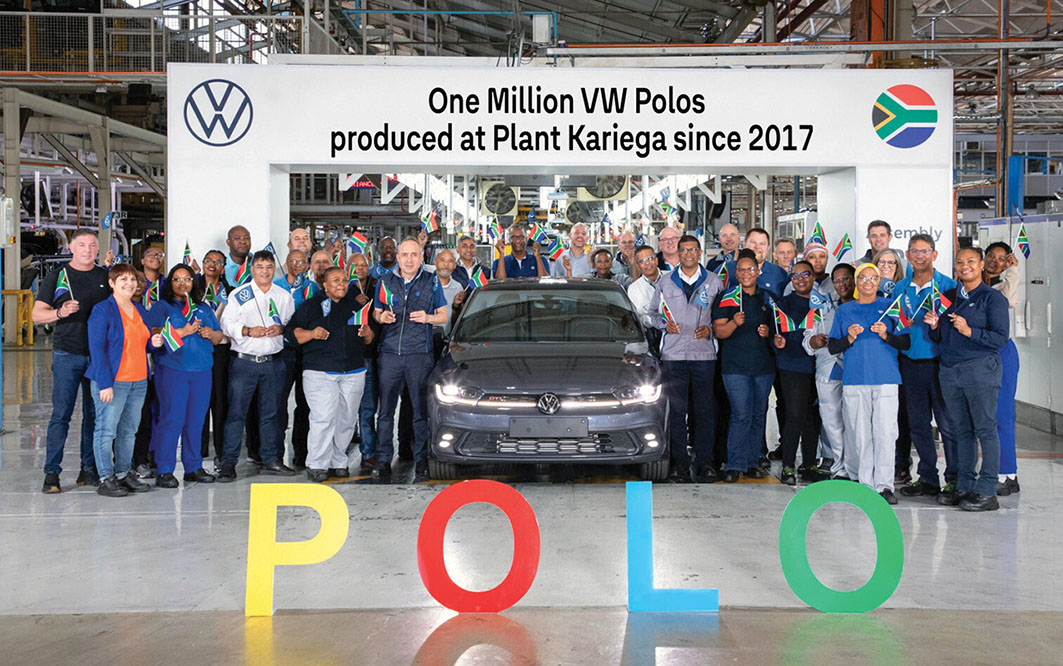
Volkswagen celebrates producing 1-millionth current model Polo in Kariega: At this time when the South African vehicle manufacturers are facing rapidly growing competition from a plethora of imported models from China and India it is wonderful to celebrate a global local manufacturing milestone in the Eastern Cape.
Volkswagen began building the current generation Polo in South Africa in 2017, with 86% of them exported to international markets, mainly, Germany, the UK, Japan, Australia, and New Zealand – with the remainder sold locally.
The plant is the sole global manufacturer and exporter of the Polo model to 38 countries. The current generation Polo accounts for nearly 21% of the 4.8-million vehicles built at the Kariega plant over the past 75 years. This wonderful achievement comes as the Volkswagen Group Africa celebrates 75 years of vehicle manufacture in South Africa, and 30 years of Polo production at the Kariega (formerly Uitenhage) plant.
VW staff count in Germany to be cut by 19 000 by year end: Just as the previous paragraph about Volkswagen’s booming Polo export programme being great news for South Africa, comes the news that the parent company in Germany will cut 19 000 heads from its staff by the end of the year, as part of a massive cost reduction programme in the global Volkswagen Group. Volkswagen says it has signed agreements from 28 000 employees to take voluntary retrenchment by 2030. This number grows to a targeted 50 000 people when retrenchment at Audi, Porsche and Cariad (the VW Group’s software company) over the same period are added in.
The radical restructuring and resizing programmes have already seen factory costs drop by 20% in 2025. The VW Group’s global maximum production capacity has also been trimmed from 13 million units a year to nine million.
Vehicle manufacturers look to building military vehicles: Volkswagen is one of several global motor manufacturers looking to diversify operations in the face of falling vehicle volume by contracting to build military equipment. VW recently displayed Amarok one-ton trucks and Crafter vans converted to fulfil military purposes at the Enforce Tac trade show. The company is already looking at building components for Israel’s Iron Dome defence system at one of its factories.
Renault, which is considering drone production at it Le Mans plant, recently displayed an SUV developed in conjunction with Thales, a global technology company, for military use. Known as the 4Troop, the 4×4 vehicle is being offered as a military command vehicle.
Mercedes-Benz is evidently considering making weapons again for the first time in 80 years. The company recently exhibited examples of military vehicles based on the G-Wagon platform and the Sprinter van at an air show in Berlin. The project involves Titan Tech, a start-up firm, and the models shown were part of a system to intercept hostile drones. Mercedes-Benz went to far as signing a memo of understanding with government representatives at the air show.
Daimler are also getting into supplying military business using their Mercedes-Benz trucks and Unimog products.
Ford and General Motors, which were both heavily involved in weapons production during World War II, are now in discussion with the Pentagon about restarting the manufacture of military equipment.
Honda “old guard” failed to oust CEO Mibe: Reuters News has recently revealed that members of Honda’s “Old Guard” were so unhappy with the way CEO Toshihiro Mibe was running the company they wanted to have him ousted but failed. Former CEO Nobuhiko Kawamoto evidently asked Mibe to resign in April, but Honda’s board backed him and he is still in his position. This was even after the company reported its first ever annual financial loss after seven decades of going public on the stock exchange. This subsequently resulted in the company writing down US$9 billion in electric vehicles costs.
The “old guard” blamed Mibe for neglecting China, the world’s largest car market, and making a “failed” bet on electric vehicles. They accused him of paying more attention to Honda’s golf sponsorship than its business!
Mibe was also involved in a failed attempt for Honda to join forces with Nissan, which has been struggling financially for the past few years. Honda wanted Nissan to be a subsidiary in the venture, and not an equal partner. This resulted in Nissan ending negotiations and is going it alone as it aims to return to financial health with radical cost cutting – such as selling the Nissan plant in Rosslyn to Chery – and aggressive forward model planning.
BYD plans to overtake Toyota for world leadership within five years: BYD’s recently announced its ambition is to become the largest maker and seller of vehicles in the world within five years. This statement was made by Wang Chuanfu, the CEO of BYD the Chinese electric vehicle (EV) company that has already overtaken Tesla as the world’s largest producer of EVs. He said the rate of growth in production and sales overseas showed the rapid progress being made by BYD (Build Your Dream).
Leading the charge is Wang’s longtime partner, Stella Li, BYD’s executive vice president, who has overseen the company’s transformation from a maker of cell phone batteries to world leadership in sales and production of EVs. According to a report in a recent edition of Automotive News Li spends more than 70% or her time outside China, meeting government officials, hiring local executives and personally shaping practising and product strategy in the various world markets.
International sales more than doubled in 2025 to over a million vehicles. In May, this year BYD sold more than 160 000 vehicles abroad, which was more than double the number of vehicles sold in the same month a year ago. It is targeting 1.5 million sales overseas in 2026.
Sheldon van der Linde is now highest placed SA driver in Le Mans 24-Hour race: Sheldon van der Linde is now the highest placed South African finisher in the gruelling Le Mans 24-Hour race, following his second place in the 2026 event. He shared a BMW M Hybrid V8 hypercar with Robin Frijns of the Netherlands and René Rast of Germany. The previous best placing for a local driver was Sarel van der Merwe’s third place in 1984. George Fouche and Wayne Taylor both had fourth place finishes, and both competed in this famous race 13 times.
This year was the third in which Sheldon had raced for BMW in the Le Mans 24-Hour, having finished 17th at year after failing to qualify as a finisher in 2024.
Sheldon (27) and his elder brother, Kelvin, are now permanent members of the BMW factory racing team. They come from a successful motor racing background in South Africa, with grandfather, Hennie, father, Shaun, and uncle, Etienne, all having won numerous national titles over a long period of time.
By Roger Houghton