BEYOND COMPLIANCE: THE STRATEGIC IMPERATIVE FOR SUSTAINABLE SKILLS
Within South Africa’s Motor Body Repair (MBR) sector, grants and sector-based funding have long served as essential mechanisms to support artisan development and improve workshop capacity. Yet, from our vantage point at C3 Auto Body Repair Academy, a consistent challenge persists across the industry: funding is too often treated as the goal rather than the tool. When grants become the destination instead of the vehicle, compliance overshadows competence – and sustainability suffers.
The compliance trap we see across the sector
Each year, countless apprentices arrive at C3 for trade testing. Many are talented and motivated but still underprepared. This is not due to a lack of potential, but because their training journey has been shaped around MOA deadlines instead of the technical depth required for mastery.
As we often summarise:
“A number of legacy apprentices fail not due to capability, but because they were never given sustained, structured technical exposure throughout their training – only a crash course weeks before testing.”
One assessor recently shared an anecdote:
A candidate could prepare a bumper with impressive speed but had never actually blended a metallic. He had watched the process for years but never touched the spray gun. Yet he was expected to perform at a qualified level the next morning.
This is not a reflection of the learner’s ability – it’s a reflection of a compliance-driven system.
When training is treated as a tick-box exercise:
- Businesses secure the grant but not the artisan
- Learners rotate without anchoring real skill
- Technical exposure becomes sporadic, not cumulative
- Production pressures overshadow long-term development.
- And the industry resets the cycle with every intake.
The overlooked commercial opportunity
Despite this, C3 has seen a recurring – and highly strategic – opportunity emerge. Many funded candidates, particularly in spray painting, begin performing at near-qualified levels long before their subsidy ends.
The numbers are compelling:
- A qualified Spray Painter earns R18 000-R30 000 per month.
- Many funded C3 candidates already perform the full scope of this role.
- Some still have 12–18 months of funding remaining.
- This is not merely a subsidy – it is production capacity at a reduced labour cost.
One MBR recounted how a subsidised C3 learner had become their “colour specialist,” consistently matching difficult blends. Yet because he was a learner, he was rotated through prep work to satisfy logbook requirements. When the funding ended, another workshop recognised his skill and hired him immediately. The original shop owner later admitted: “I didn’t realise how valuable he was until he left.”
This happens all too often: workshops lose the very talent they helped build because the training focus was compliance, not strategic deployment.
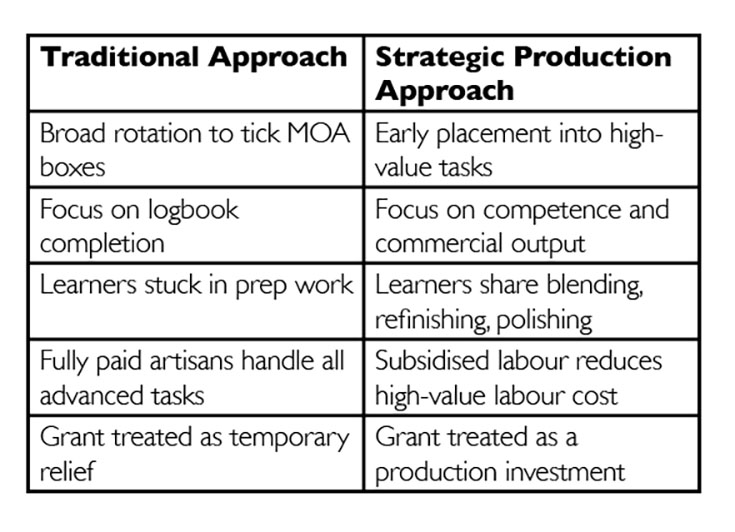
Shifting from compliance to production-centred development
To unlock the full value of funded training, MBRs must redefine success. The goal is not completing compliance steps – it is retaining a competent artisan who meaningfully contributes to production.
Every subsidised hour a learner spends in the spray booth – typically the workshop’s greatest bottleneck – increases throughput while reducing labour cost. For many MBRs, this single shift can:
• Increase weekly job cards
• Improve cycle times
• Reduce overtime for senior painters
• Strengthen insurer KPIs
• Raise monthly revenue without expanding headcount.
This is the ROI the sector is unintentionally forfeiting.
The grant is not the destination – it is the vehicle
From C3’s perspective, training grants were never intended to serve as short-term cash flow supplements. They exist to help the industry build internal talent, reduce dependency on scarce artisans, and stabilise production capacity long-term.
MBRs should be asking:
“How do we use this funded period to build an indispensable artisan who strengthens our business long after the grant ends?”
When businesses shift from transactional to strategic training:
• Competence rises
• Retention increases
• Production stabilises
• Skills shortages shrink
• Business sustainability grows.
The difference is not the size of the grant – it is how the workshop uses it.
A call to the sector to build skills that stay
As C3 Auto Body Repair Academy, our commitment is not only to certify artisans but to support the sustainability of the entire MBR ecosystem. The sector’s next leap forward requires a shift in mindset:
- From compliance to competence
- From rotation to mastery
- From funding relief to long-term production strategy.
Ultimately:
• The grant is not the win
• The artisan you retain – skilled, confident, and commercially productive – is the win
• And that is how the South African MBR sector will grow:
Not through more funding, but through smarter use of the funding already in place.
By Neo Moshabela