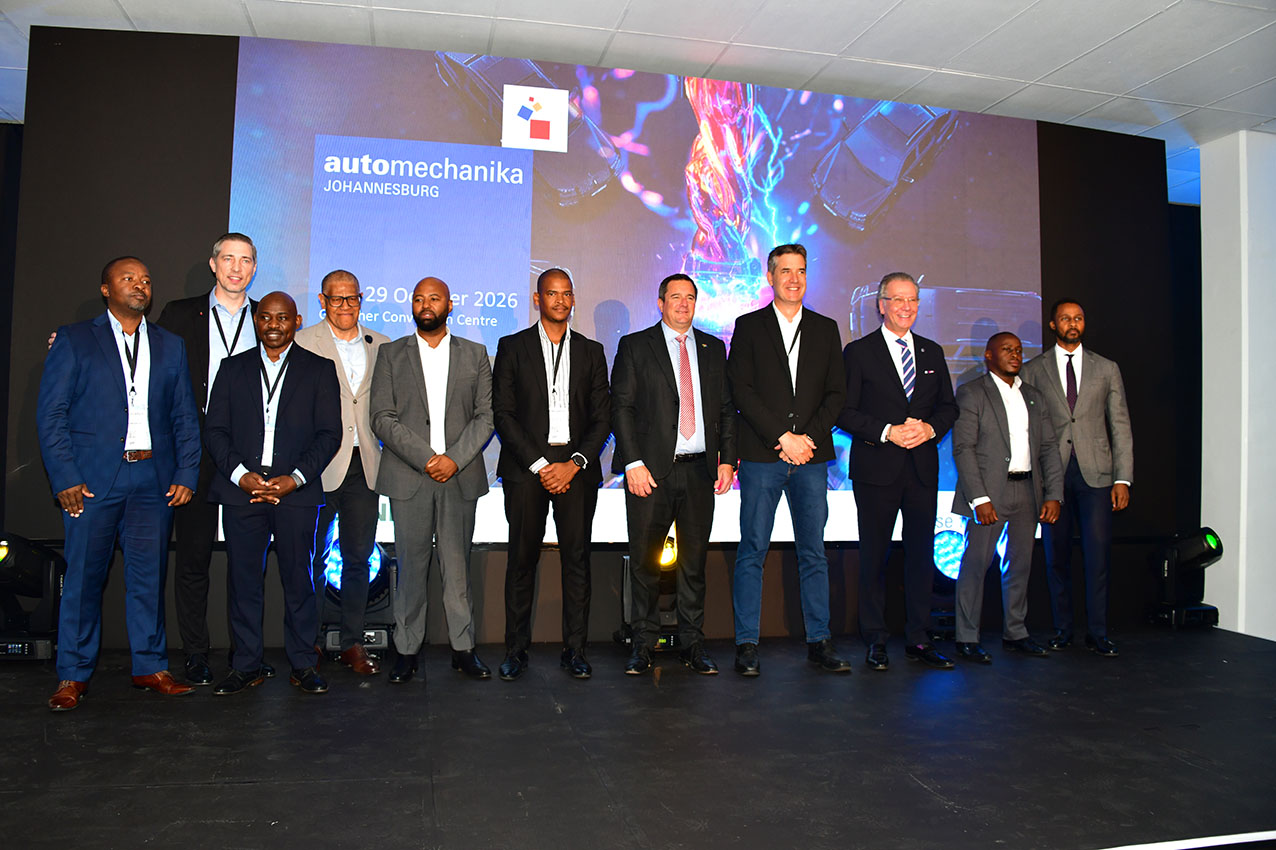
AUTOMECHANIKA CEO BREAKFAST SETS AGENDA FOR AFTERMARKET GROWTH
Industry leaders, government representatives and development partners called for coordinated action on localisation, skills, investment and African trade at Automechanika Johannesburg’s CEO Breakfast, held on the international trade fair’s opening day.
Sponsored by Nedbank and hosted by Messe Frankfurt South Africa, the gathering examined how the automotive aftermarket can strengthen industrial competitiveness, expand economic participation and sustain affordable, safe mobility.
Programme Director Victor Radebe championed small businesses and township mechanics, urging stronger connections to new technologies, training and mainstream opportunities. “It’s about the 13 million cars that are on the road. And it’s also about small businesses,” he said. He highlighted the exhibition’s longstanding support for township mechanics and called for skills development to equip them to service newer vehicles.
Michael Johannes, Vice President: Mobility and Logistics at Messe Frankfurt Exhibition GmbH, outlined the opportunities presented by a growing, ageing global vehicle fleet. He stressed education, cooperation and affordable mobility. “Automechanika stands for innovation, sustainability, but also for transformation and education,” he noted.
Deputy Minister of Trade, Industry and Competition John Steenhuisen positioned the automotive aftermarket as central to localisation, regional exports, road safety and circularity. Citing R107.5 billion in replacement parts imports during 2025, he highlighted opportunities to retain value domestically. “Localisation must extend beyond the factory gate,” he said, urging investment in technical capability alongside technology.
Investment and inclusion through practical partnerships
Siyabonga Mthembu, Partner at BDO, presented research on shifting global production, growing Chinese brands and South Africa’s ageing vehicle fleet. He identified infrastructure constraints and priorities including sourcing, inventory, affordability, productivity and skills. “We produce more but we’re seeing less and less profitability,” he lamented.
Takatso Sello, Senior Manager Manufacturing at Nedbank, urged faster implementation and coordinated financing to protect manufacturing competitiveness. He encouraged businesses to pursue opportunities in local production and stronger supply chains. “Let’s make transactions that are sustainable and that can shape and move the sector forward,” he pleaded.
Greg Cress, Principal Director Automotive and eMobility at Accenture South Africa, outlined opportunities for reindustrialisation through policy certainty, advanced manufacturing and investment in electric vehicles, charging infrastructure and battery assembly.
He described a future of work involving digital colleagues and human oversight of robotics, supported by continuous learning and “AI-enabled artisans”. “Humans need to do the thinking, the judgment, the accountability, and ask key questions around it,” he said. “We also have to invest in learning and co-learning with robotics”.
Bobby Ramagwede, CEO of the Automobile Association South Africa, raised concerns about recall transparency, vehicle safety, transport affordability and industrial policy, calling for stronger accountability. “Let’s take ownership of this industry,” he urged.
Closing proceedings, Michael Dehn, Managing Director of Messe Frankfurt South Africa, announced plans for an Automotive Incubator Highway connecting African markets and supply chains. “We are going to intensify our connective initiatives,” he declared.