ACCELERATING VEHICLE TECHNOLOGY IS DRIVING REPAIR CONVERGENCE
It’s been some months since Santam motor book insurance embarked on modernising clear objectives and a new pathway to less friction for their policy holders in their journey through the unforeseen event of a vehicle loss or accidental damage repair. Vehicle technology convergence influences two key objectives of Santam’s guiding principle objectives: honouring their client’s indemnity against loss, and secondly, treating customers fairly. This process will ultimately see fewer steps and deliver when it matters most to strengthen human connections with policy holders.
The transformation must be viewed against a backdrop of being capable of providing focus on helping customers protect what matters most in a world that can feel increasingly disconnected. Santam hold an overall clear principle that technology should strengthen their human connections, not substitute it.
Included in the tech-enabled survey are body shops’ expertise, training, vehicle measuring, and approved training of staff to gain an overall view of transition into the future of collision repair expertise. The industry, along with key trade organisations, have been vocal in recent months about a move from Santam to engage in increased levels of commercial payments on both labour charge-out rates as well as faster implementation of refinish paint refinishing actual costs.
Santam remains the largest centralised broker, driver, and corporate concern, and are in full realisation of the trade changes that are taking place with the electric hybrid vehicles and other Chinese vehicles suppliers into the South African market. They can confidently predict that more changes will take place in the next few years than in the previous decade with a vast increase in available model derivatives, and the team at Santam are preparing for these changes.
Santam are also engaging a private training specialist concern to uplift 15 of their customer relationship managers to increase their trade process knowledge in refinish, with the objective of motor insurance value upliftment in future technologies and trends, as well as richer all-round knowledge of repair.
Santam & UYilo e-Mobility Programme EV Masterclass 2026
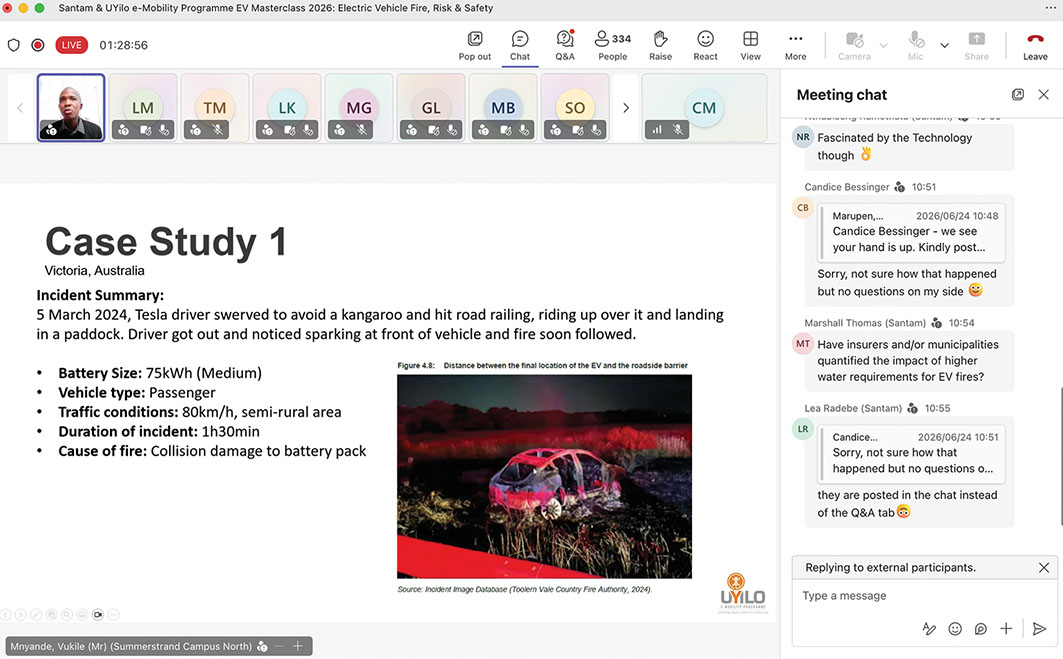
Staying up to date in the world of EVs is essential in underwriting as well as repair. With this in mind, Santam hosted an EV Masterclass online with over 380 people in attendance. Vukile Mnyande and Reuben Mabeo were the speakers involved on the day and they highlighted some interesting facts and figures.
Research from Norway and Sweden – who hold the world’s most EVs per capita – shows that the event of an EV fire is lower than first thought. An ICE vehicle is five times more likely to catch fire.
Locally CSIR and SANRAL have put together NEV guidelines for first responders, which was launched last December. Fighting lithium battery fires requires specialist training equipment as well as firefighting resources and, in most cases, an untrained person cannot extinguish these fires safely. On average it takes up to 20 000 litres of water to extinguish a lithium battery fire. As an average fire truck carries 1600 – 4000 litres, there would need to be more than one unit on site to help put out the fire. Fire blankets to contain flames and prevent damage to surroundings is essential, otherwise you wait for the car to burn out if water is in short supply and if this is an option.
The hazardous gases are fatal and anyone responding to a fire like this needs to have a self-contained breathing apparatus (SCBA), as well as specialised insulated tools, high voltage insulated gloves, a face shield and a thermal camera.
Key approaches in extinguishing fires as well as storage and recycling of lithium batteries were also discussed. There is a definite need for lithium battery recyclers in South Africa, as there are only two in the country as far as can be determined. The transport of damaged batteries is also concerning as they would need to be transported with help as they could also catch alight again, and this coupled with long distances is not a great outcome.
Several case studies were discussed from around the world on why each EV had caught fire, how the clearance and recovery of the vehicle and battery had been handled, what the response deployment was as well as lessons learned.
At this stage and time, that is what we can do – listen, study, dissect, learn and then implement the best way forward with this new technology that is here to stay – whether in BEVs or hybrids.