1955 CHEVY THE HOT ONE!
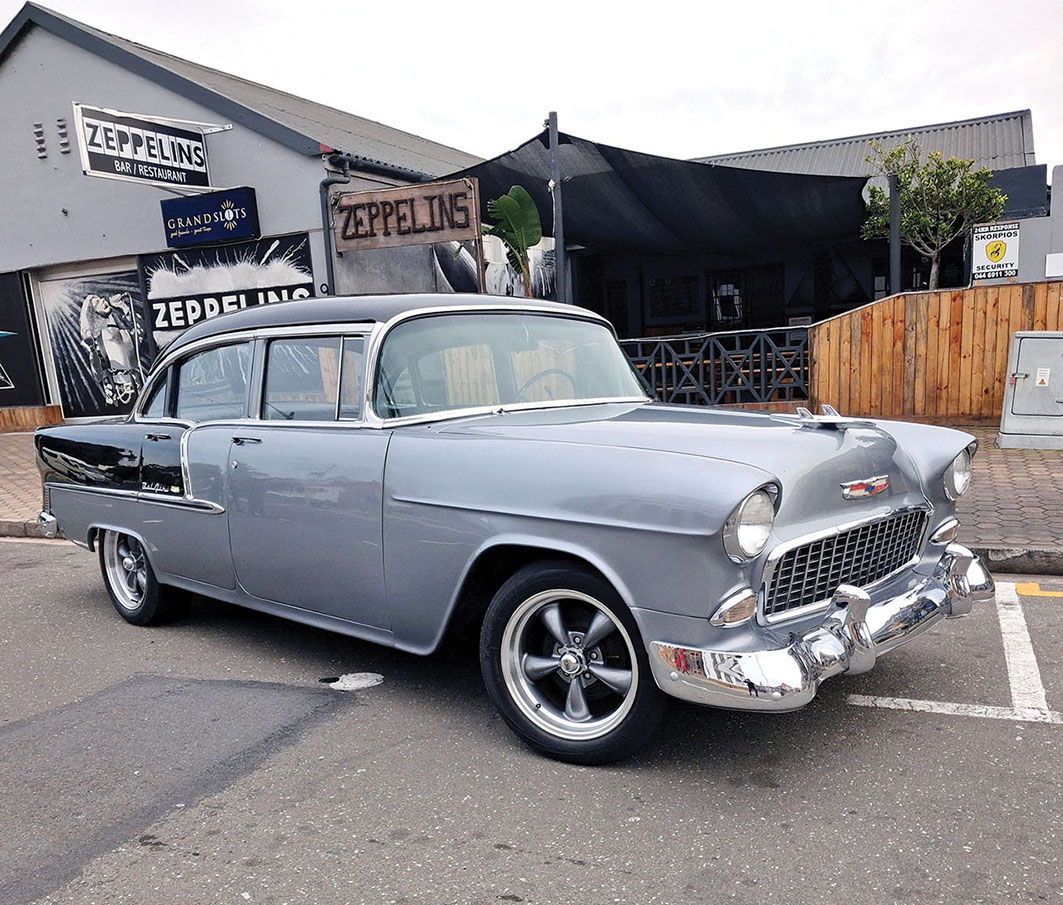
Nothing really prepares you for how good the 1955 Chevy is, in the context of its time. This thought became uppermost in my mind as we cruised west in Sam Cloete’s ’55 on the road out of Mossel Bay towards Cape Town, on a typical overcast winter’s day in the southern-most part of our country.
Step back 70 years, and you’ll realise that this was the year that saw the launch of the definitive small-block V8 engine from Chevrolet, the most successful engine in the 140-year history of the automobile, which most people agree can be pegged in 1886, when Karl Benz produced his street-going version of the horseless carriage.
From 1955 onwards, Ed Cole’s small block V8 design found its way into just about every configuration of Chevrolet ever imagined over the next 60 years, and well over 100 million of them have been produced!
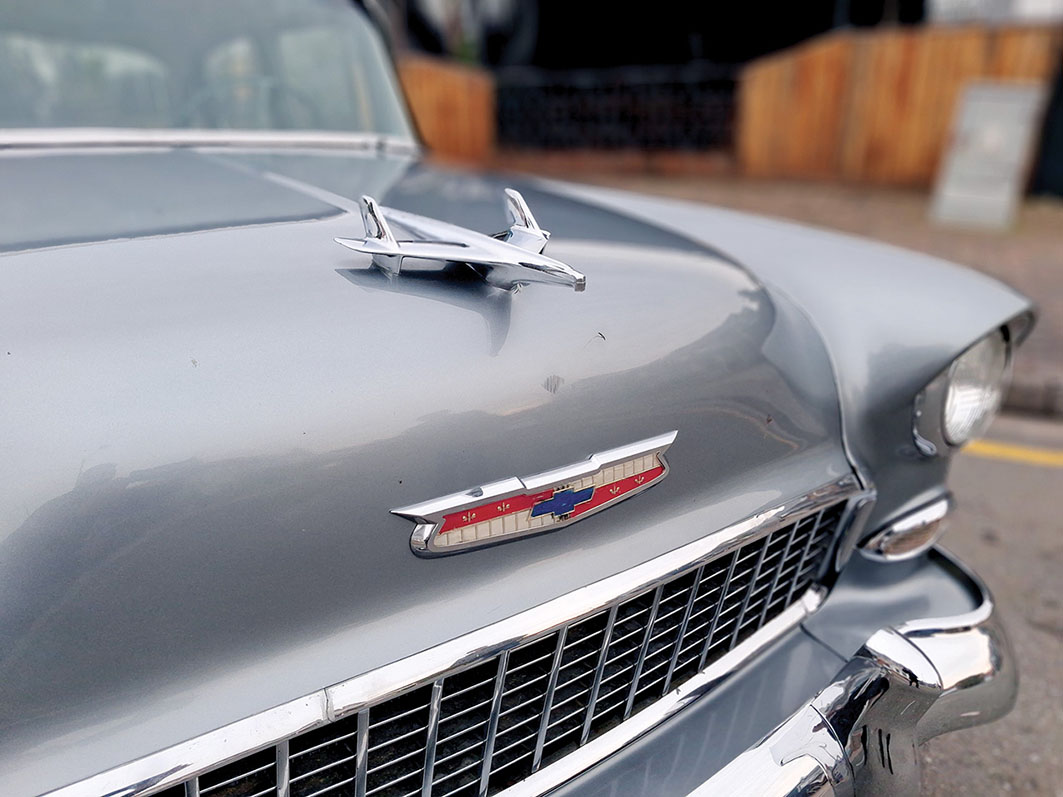
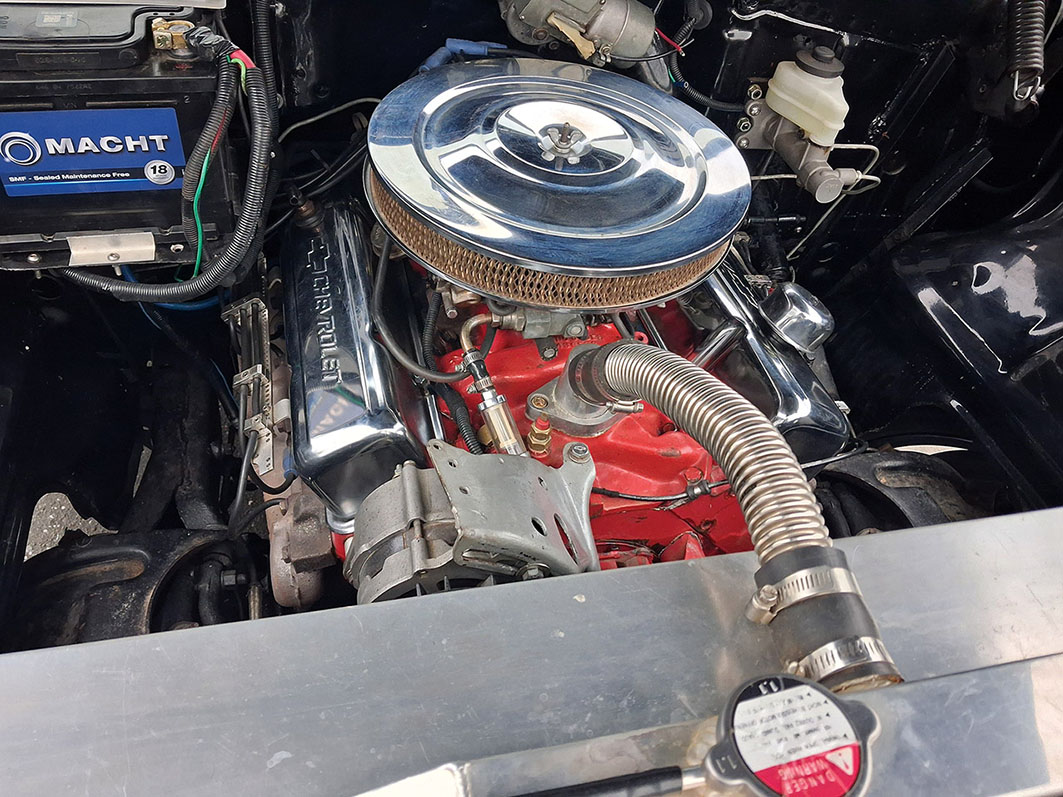
The Chevy Bel Air was launched (it was also available with Chevrolet’s long-lived straight-six-cylinder engine) with a 265 cubic-inch (4.3-litre) V8, but the motor now fitted to resto-modded Sam’s ’55 is the definitive small block Chevy V8, launched in 1967 with the Chevrolet Camaro. Open the beautiful gunmetal bonnet with its heavy, plated metal aeroplane mascot, and it’s a most reassuring experience. There’s nothing fancy there, nothing too modern – a four-barrel carb nestling under a chrome air-cleaner, dressed up valve covers, purpose-made exhaust manifolding, and the original distributor allied to conventional plugs and plug leads.
The first moment of surprise came when Sam floored the throttle and the Turbo 350 three-speed automatic gearbox (that’s just the name of the gearbox; there’s no such thing as a turbo-charged gearbox) dropped a ratio and that small block Chevy came to life. It was ‘abso-friggin-lutely’ smoooooth, spinning up with no trace of vibration to the 5 500 red-line, in a manner you’d rather expect of a modern BMW or Mercedes-Benz V8.
Part of the reason it revved up so quickly was that Sam has yet to install the taller-ratio Chev El Camino diff he has in his workshop. But, like most resto-classics that have been fully re-built from the chassis up, the car is still evolving, albeit always with a view to retaining a direct lineage back to the original car.
One of the reasons that the V8 felt so smooth was that, just as it was in 1955, the dynamically refined motor is mounted in a very solid box-steel cross-frame chassis, re-designed that year by Chevrolet, so the passengers inside the car are insulated from the finer-frequency vibes that you would experience in, say, a Camaro, or to use an extreme example, a Chev Firenza Can Am.
Separate chassis and body configurations were a feature of all full-sized Chevy sedans built into the 1980s, whereas smaller European and Japanese cars embraced the monocoque (one-piece chassis and body construction) from the 1950s. It is said that the monocoque construction method gives a more solid feel to a car, but, again in Sam’s Chevy, this separate-chassis car felt beautifully solid over the type of ripples and undulations you will often find in a typical South African town.
A third supposition that had to be junked was that the ’55, like just about all American cars of that era, would wallow around and nose-dive under heavy braking.
“I fitted Gabriel adjustable shocks front and rear, and installed them on their hardest setting, and I must say, they have transformed the handling of the car, compared to the original set-up,” says Sam. “I am still using the original springs and the drum brakes that the car came with 70 years ago, and they stop the Chevy very well. You can do a heavy stop once or twice and as long as you use enough pressure on the brake pedal, all goes well. But with repeated heavy braking, such as down a windy mountain pass, disc brakes would be more desirable! Incidentally, disc brake kits are available for these ‘55s to fit without too much trouble.”
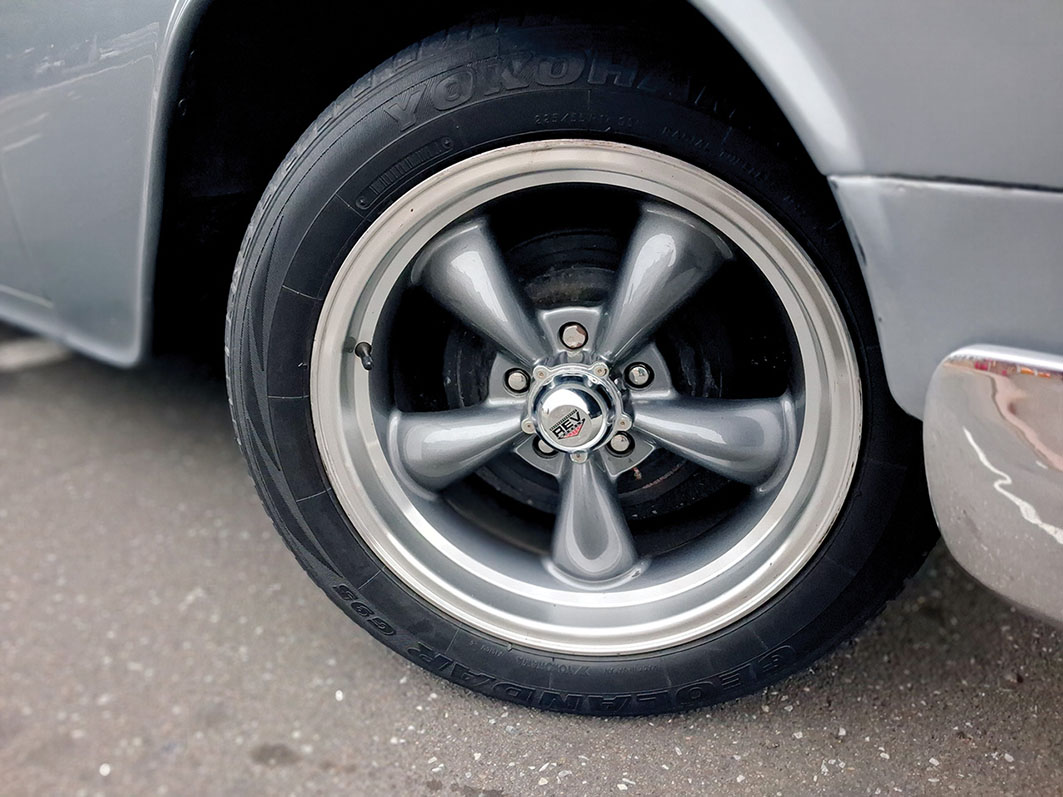
Another change from standard is the fitting of 17-inch American Racing five-spoke alloy wheels and 50-series tyres in place of the old steel 15-inchers the car came with, along with skinny, high-profile, cross-ply rubber. Handling remains simply smooth and solid. Just the way we would like it to be.
Sam Cloete took four years to re-build his ’55 Chevy but says the restoration could be done much faster if that was the only project you had in mind. Sam, now 70 years old, has restored a number of cars including a 1958 Chevrolet Impala, a few other Chevys, and a couple of Renault Gordini’s. In fact, his next project is a Gordini, a car that is a polar opposite of a ’55 Chevy, with a monocoque chassis, and a high-revving four-cylinder engine mounted in the rear.
There was so much to admire in that short ride we took together in the ’55, not least of which was the way the doors closed absolutely perfectly, and that there were no rattles whatsoever in the car. The interior has been left completely standard, and the original seats have been retained, re-upholstered by a colleague of Sam’s in Mossel Bay at Fanie’s Upholstery. The tasteful gunmetal silver and black paint work as done by another colleague of Sam’s called Shane, who was operating a business from the same complex in the ’Moss industrial area where Sam has his workshop.
A totally unexpected aspect of living in a 1955 Chevrolet is that you sit much higher than you would expect to do. Then you compare the car to a modern five-seater and realise that the ’55 is a big car and a tall car; it just looks sleek and relatively small because of the subtlety of its styling.
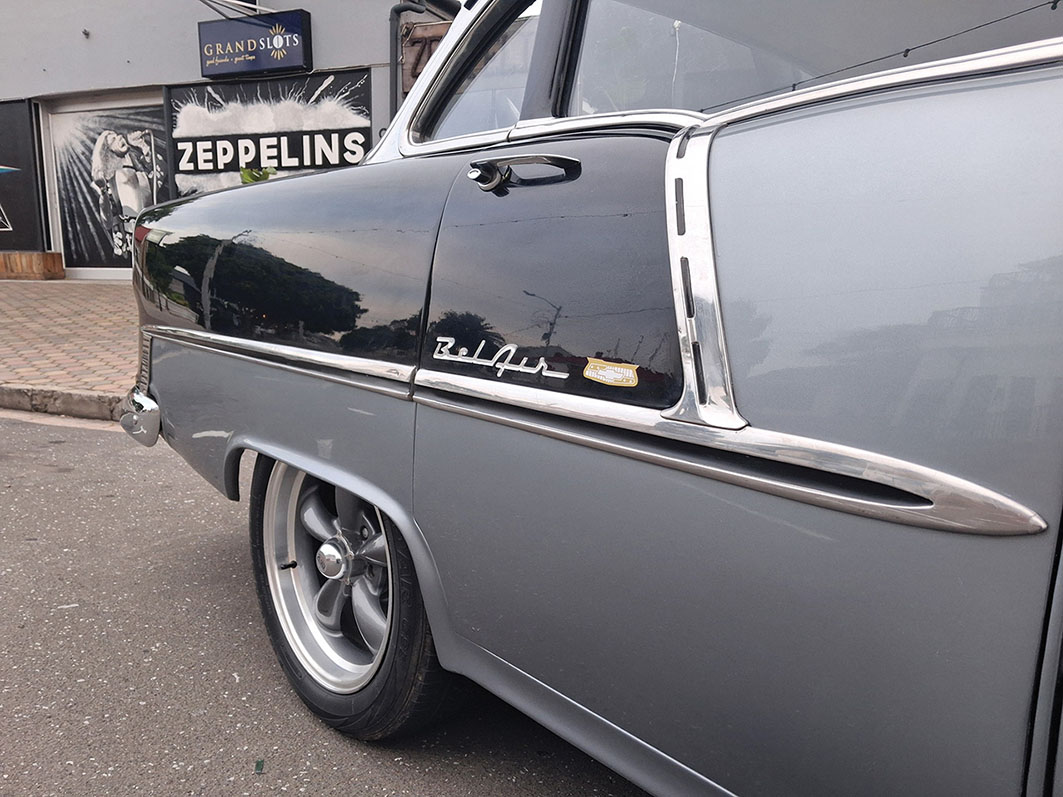
Sam is proud that the bulk of the stainless-steel trim and chromed steel bits on his car are still 100 percent original. The only bits he is still waiting for are those “Bel Air” badges on the flanks, hence his stick-on vinyl mock-ups that do duty until he finds time to order up the correct reproduction parts from the USA.
With the wisdom of hindsight, it is no surprise that the 1955 Chevy became instantly known as the hot-rodders’ go-to new car, with the small-block Chevy V8 gaining instant acceptance as the new engine swap of choice, after Ford had had things all its own way with its famous Flathead V8 that had debuted way back in the ’30s.
The classic three-box design of the ’55 remains my favourite of the so-called Tri-Chevy years (1955-’57) because it is so understated, with its mere hint of tail fins and minimal flash in terms of metal brightwork. Yet other elements of its appearance lend themselves to a bit of extra aftermarket menace, such as a big bonnet scoop for a GMC Supercharger perhaps, and naturally some fat tyres and stylised wheels… This is thanks mainly to the original equipment egg crate grille that, according to legend, was inspired, by the Ferrari 166 Mille Miglia!
All power to Sam Cloete and his resto-rod, which doubles as a full five-seater, when need be, but can still out-drag many a modern conveyance when red turns to green at the traffic lights. Those hot rodders turned out to be right on the button as usual, when they referred to the ’55 Chevy quite simply as “The Hot One”.
Story and pics by Stuart Johnston